• Follow Us On :
GERMANY MEDICAL PG ADMISSIONS

Build Your Medical Career In Germany with World-Class PG Training

Achieve your dream of pursuing Medical PG in Germany through structured guidance, German language training, licensing support, and hospital placement assistance. Start your journey toward an internationally recognized medical career.

Start Your Medical PG Journey

Fill out the form below and our expert counsellors will contact you to discuss eligibility, language training, licensing, and the complete Medical PG pathway in Germany.

AUSBILDUNG IN GERMANY FOR INDIAN STUDENTS

Start Your Career in Germany Through Ausbildung

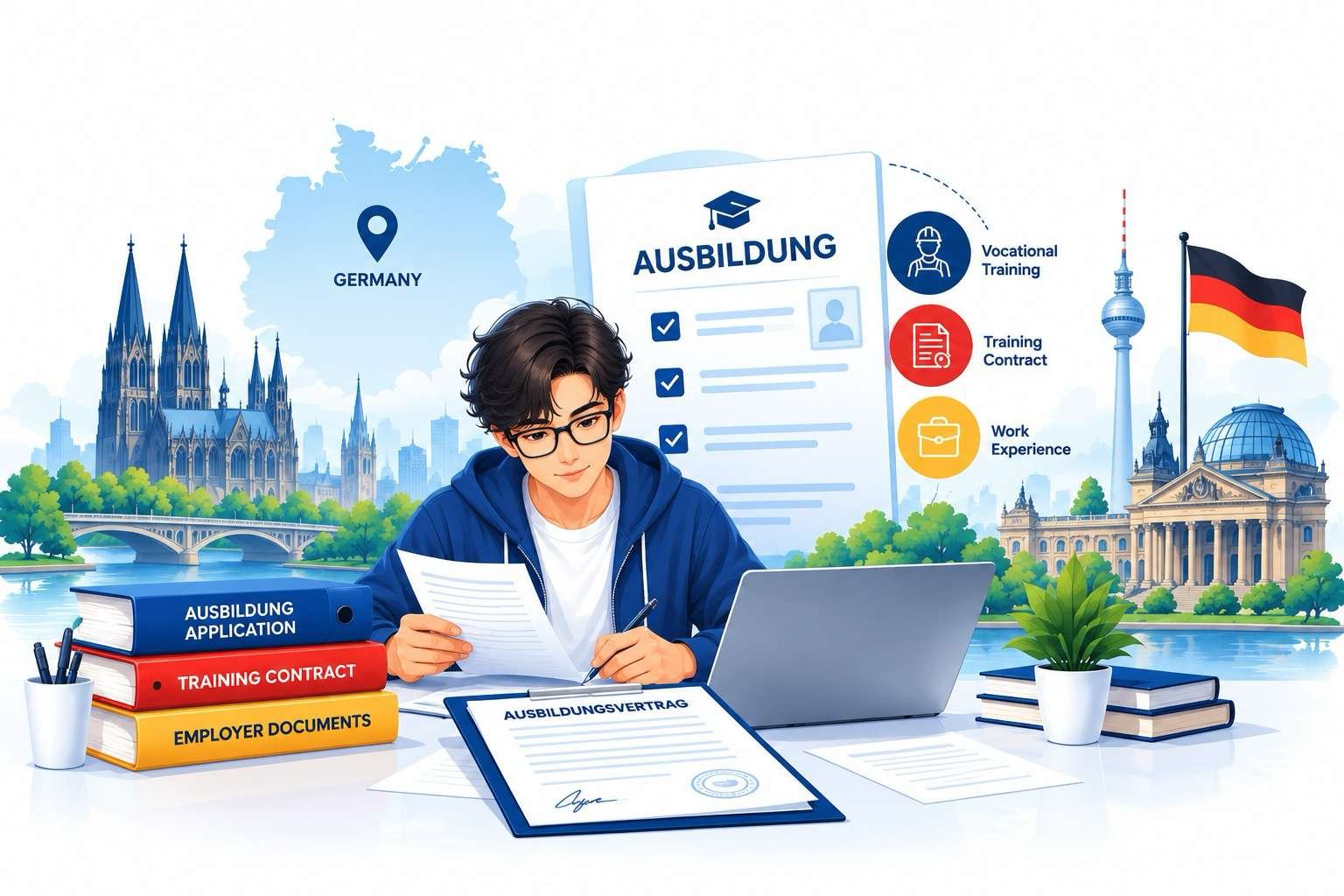
Ausbildung is Germany’s vocational training system, designed for students who want to learn a profession through a combination of practical work and classroom training.

Unlike a traditional university degree, Ausbildung focuses strongly on job-oriented professional skills and practical experience. In most of the company-based Ausbildung programs, students receive a monthly training allowance while learning their profession.

For Indian students who have completed Class 12 and want a practical career pathway in Germany, Ausbildung can be an option worth considering.

Contact Form Main

Ausbildung in Germany Eligibility & Requirements

Discover the eligibility criteria, German language requirements, educational qualifications, and essential documents needed for Indian students to pursue vocational training in Germany.

What Is Ausbildung?

Ausbildung is a structured vocational training program in Germany. Depending on the profession, Ausbildung generally combines:

  • Practical training with a company
  • Classroom/theoretical training at a vocational school
  • Professional examinations
  • Practical work experience
  • Training allowance in most of the dual/company-based programs

Most dual Ausbildung programs take approximately 2–3.5 years, depending on the profession.

Who Can Apply for Ausbildung?

Indian students can consider Ausbildung if they meet the requirements of their chosen profession and visa route.
Generally, applicants should have:

  • Completed Class 12 or equivalent education
  • Students with mediocre education grades can apply
  • A valid Indian passport
  • Required German language proficiency is mandatory
  • Suitable academic background for the selected profession
  • Genuine interest in the chosen career
  • Required documents for the application and visa
  • Sufficient financial resources when required
  • Students should have patience for Ausbildung process

Important : Requirements can differ from one Ausbildung profession and employer to another.

Is Ausbildung Suitable
After Class 12
for Indian Students ?

Yes. Indian students who have completed Class 12 can apply for suitable Ausbildung programs.

The right program depends on:

  • Your Class 12 subjects
  • Academic performance
  • German language level
  • Age and individual profile
  • Career interests
  • Previous work experience, if any
  • Requirements of the employer or training institution

Students with a bachelor's degree or work experience may also be eligible for suitable Ausbildung programs.

Ausbildung vocational training in Germany

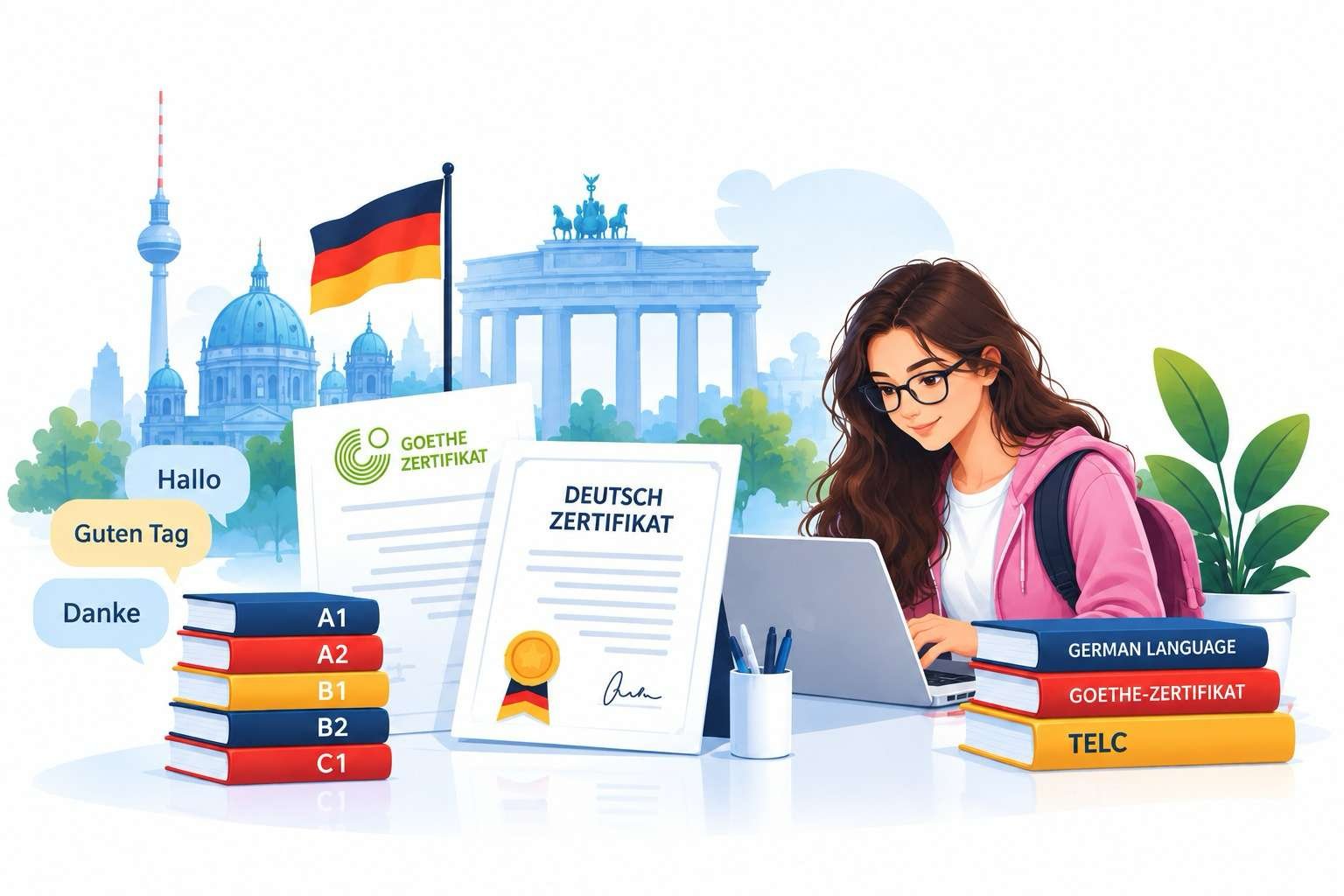
German Language Requirement

German language is one of the most important requirements for Ausbildung.

Training, workplace communication and examinations are generally conducted in German.

A1–A2 Beginner level Beginner level – generally not sufficient for most Ausbildung positions.
B1 A common target A common target level for many Ausbildung pathways and an important level for international applicants.
B2 May be required May be required or strongly preferred for certain professions, particularly where communication with customers, patients or colleagues is important.
HEALTHCARE Additional requirements Healthcare professions: Nursing and other healthcare-related professions can have additional language and professional requirements.

The exact requirement should always be checked for the specific Ausbildung position and visa application.

Popular Ausbildung Programs in Germany

Germany offers Ausbildung in many different industries.

Healthcare Ausbildung programs in Germany

Healthcare

  • Nursing / Pflegefachkraft
  • Healthcare-related professions
  • Medical assistance-related professions

IT and Technology Ausbildung programs in Germany

IT & Technology

  • IT Specialist
  • System Integration
  • Application Development
  • Digitalisation-related professions
Engineering and Technical Ausbildung programs in Germany

Engineering & Technical

  • Mechatronics
  • Electronics
  • Electrical Engineering
  • Industrial Mechanic
  • Metal Technology
Logistics and Transport Ausbildung programs in Germany

Logistics & Transport

  • Logistics Specialist
  • Warehouse Logistics
  • Professional Driver
  • Transport-related professions
Hospitality Ausbildung programs in Germany

Hospitality

  • Hotel Management
  • Restaurant & Gastronomy
  • Cook / Chef
  • Food-related professions
Business and Retail Ausbildung programs in Germany

Business & Retail

  • Retail Sales
  • Wholesale & Foreign Trade
  • Office Administration
  • Commercial professions
Construction and Skilled Trades Ausbildung programs in Germany

Construction & Skilled Trades

  • Construction-related professions
  • Plumbing & Heating
  • Electrical Trades
  • Carpentry and other skilled trades

The availability of Ausbildung positions changes every year and depends on employers and regions in Germany.

Ausbildung Process for Indian Students

1

Profile Evaluation

Your education, German language level, academic background, interests and career goals are reviewed to identify suitable Ausbildung options.

2

Choose Your Profession

Select an Ausbildung based on your:

  • Education
  • Skills
  • Interests
  • Career plans
  • Language level
  • Eligibility

Choosing the right profession is important because Ausbildung is a professional career pathway.

3

Learn German

Prepare for the required German language level and obtain the appropriate language certificate.

For many international applicants, B1 is an important target level.

4

Prepare Your Documents

Prepare your academic, personal, language and application documents.

5

Apply to Ausbildung Positions

Applications are submitted to suitable companies or vocational training institutions in Germany.

Applications may include:

  • CV
  • Motivation letter
  • Educational documents
  • Language certificate
  • Supporting certificates
6

Attend Interviews

Shortlisted candidates may be invited for:

  • Online interview
  • HR interview
  • Professional interview
  • Language assessment
  • Practical/technical assessment, depending on the profession
7

Receive the Ausbildung Contract

When selected, the employer provides an Ausbildungsvertrag (training contract).

This is one of the most important documents required for the next stage.

8

Apply for the German Visa

After receiving the required training documents, prepare and submit your application for the appropriate German national visa.

9

Travel to Germany

After visa approval, travel to Germany and begin your Ausbildung.

YOUR NEXT CHAPTER

Build Your Future in Germany

Turn your career ambitions into reality with the right Ausbildung pathway. Get expert guidance to start your journey with confidence.

Start Your Journey →

Students preparing for their professional future
Your Career in Germany Take the first step today

Documents Required

Your Germany Ausbildung journey starts with the right decision. We don’t just submit applications for Ausbildung. We help you understand your options, prepare your applications, arrange interviews, help with VISA application and move step-by-step towards your goal of starting your Ausbildung in Germany.

Profile Evaluation
STEP

01

01

Academic Documents

Class 10 certificate and marksheet Class 12 certificate and marksheet Graduation documents, if applicable Academic transcripts Professional certificates, if applicable
02

Personal Documents

Valid passport Passport-size photographs Birth certificate, where required Updated CV Motivation letter
University & Course Selection
STEP

02

Eligibility Check
STEP

03

03

German Language Documents

German language certificate Other language certificates, if applicable
04

Ausbildung Documents

Ausbildung application Training contract / Ausbildungsvertrag Employer documents Vocational school documents, where applicable Work experience certificates, if applicable
University Shortlisting
STEP

04

dMAT Guidance
STEP

05

05

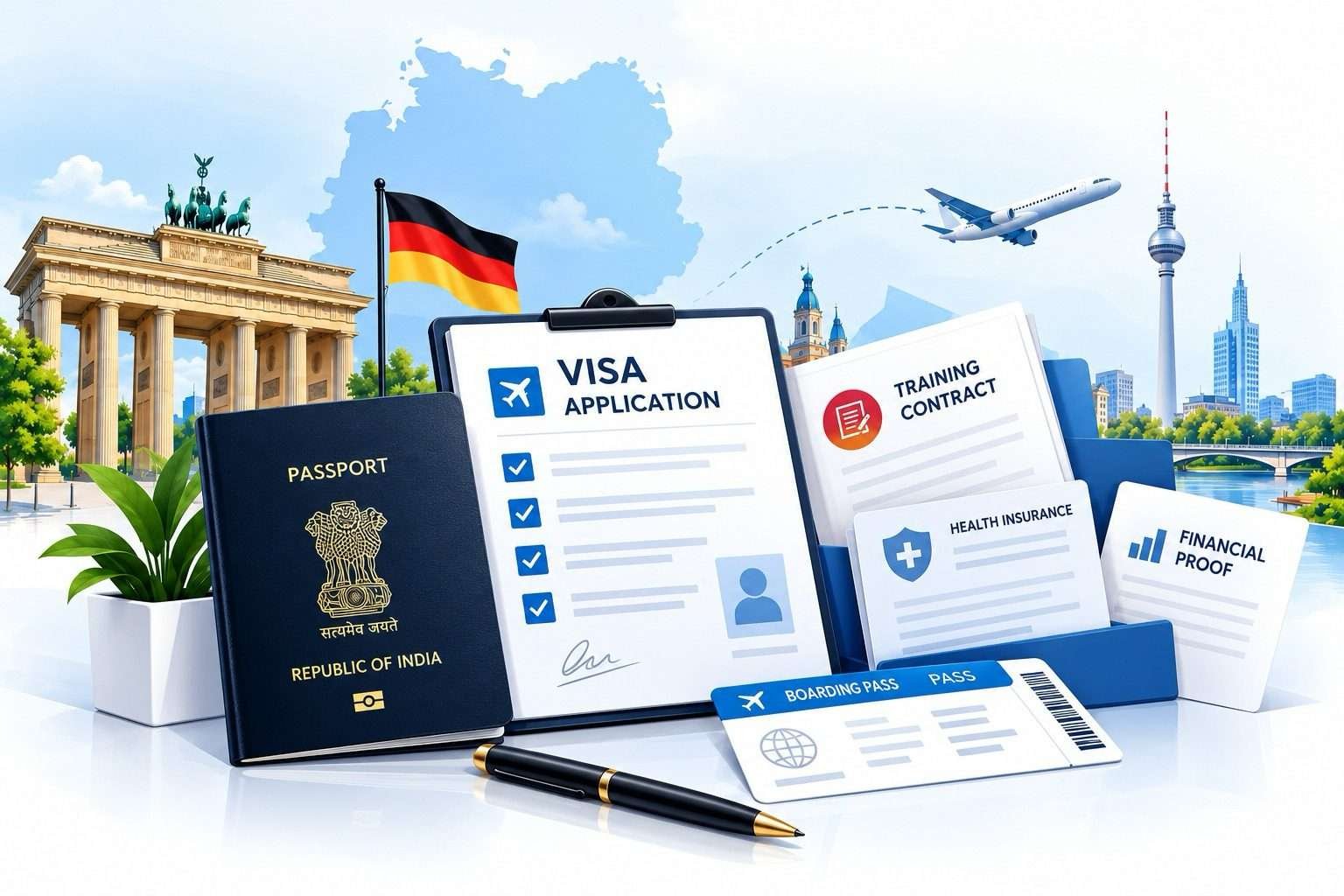
Visa Documents

Completed visa application Valid passport Ausbildung contract Educational documents German language certificate Proof of financial resources, where required Health insurance Accommodation information, where required Other documents requested by the German authorities

What Does MissionGermany Do For You?

Your Germany journey starts with the right decision.
We don’t just submit applications. We help you understand your options, choose suitable public universities, prepare your applications and move step-by-step towards your goal of studying in Germany.

We first understand your academic background. We check your marks, degree, subjects and qualifications. We also consider your language level and future career plans. This helps us understand which study options may be suitable for you.

We help you identify suitable German public universities. We look at courses that match your educational background. We explain the course structure, duration and admission requirements. We help you understand which options are realistic for your profile.

Every German university can have different admission requirements. We check your eligibility before you apply. This may include your subjects, grades, ECTS credits and previous qualification. This helps reduce the risk of applying to unsuitable programs.

We prepare a practical list of universities and courses. The final list depends on your individual profile and the actual admission requirements.

Some students may need to take the dMAT examination, depending on the program and university requirements. We help you understand whether dMAT is applicable to your chosen course.

Indian students applying for many German university programs need an APS Certificate. We guide you through the APS application process. We help you understand the documents and steps required.

Some programs are taught in English, while others are taught in German. We explain the language requirements of your selected course.

Different universities have different application deadlines. Some applications are made through uni-assist, while others are submitted directly to the university. We help you plan where and when to apply. This helps you avoid missing important deadlines.

We guide you in preparing important documents such as:
  • Academic certificates
  • Mark sheets and transcripts
  • CV
  • Statement of purpose (SOP)
  • Recommendation letters, where required
  • Language certificates
  • APS-related documents
  • Other university-specific documents

We help you complete your applications correctly. Applications are submitted through uni-assist or the university's official portal, depending on the university. We check the application before submission to minimise avoidable errors.

After submission, we keep track of the application process. We help monitor:
  • Application status
  • Missing documents
  • Additional requirements
  • Important deadlines
  • University communication

Once you receive a university response, we help you understand it. We explain your admission letter or conditional admission. If the university asks for additional documents, we guide you on the next steps. We help you get enrolled to the university.

We guide you through the German student visa process. This includes guidance regarding:
  • Financial proof
  • Blocked account
  • Health insurance
  • Visa documents
  • Appointment and application preparation

Studying at a German public university can be much more affordable than many private universities. However, “low or no tuition fee” does not mean studying in Germany is completely free.

Finding accommodation in Germany can be challenging, especially in popular student cities. We also explain what students should look for before accepting accommodation.

Before you leave India, we help you prepare for Germany. We provide guidance regarding:
  • Travel preparation
  • Accommodation
  • Packing list etc

Our support does not necessarily end when you land in Germany. We provide initial guidance regarding important formalities. This may include:
  • City registration
  • University enrolment
  • Health insurance
  • Banking
  • Other initial requirements

We clearly explain our consultancy/service charges. Students should always know what they are paying for.

We do not promise 100% admission. University admission is decided by the university. Visa decisions are made by the relevant German authorities.

Admission requirements can change from one university to another. Rules and deadlines can also change. We aim to provide guidance based on the latest available official information. MissionGermany aims to support students through the complete journey:

Profile Evaluation
 → Course & University Selection
 → Language & Test Guidance → APS & Document Guidance
 → University Shortlisting → Application Preparation → University Applications → Application Tracking → Admission Support
 → Visa Guidance → Accommodation Guidance → Pre-Departure Support
 → Arrival & Initial Guidance in Germany

Your Journey to Germany

How Long Does the Ausbildung Process Take?

Start planning 9–15 months before your intended Ausbildung start date.

9–15 Months
01

Profile Evaluation

1–2 weeks
Profile evaluation and career planning
02

German Language Preparation

3–8+ months

Language learning and classroom preparation
03

Document Preparation

2–4 weeks
Preparing application documents
04

Ausbildung Applications

1–3 months
Online applications and job searching
05

Interviews & Selection

1–3 months
Professional interview and candidate selection
06

Contract & Visa Application

2–6 weeks
Administrative preparation and application process
07

Visa Processing

Depends on authorities
Airplane representing travel to Germany
!

Timelines vary depending on language level, profession, employer availability, application cycles and visa processing.

MissionGermany pathway

Your Step-by-Step Journey to Germany

A clear, guided 7-step pathway—from profile evaluation and language preparation to your training contract and visa process. Select any step to explore what happens next.

Step 1 of 7 · Getting started 14% explored
01 / 07
Step 01 · Start here

Profile Evaluation

Typical duration: 1–2 weeks

We review your education, experience, interests and current German-language level to help identify a suitable Ausbildung direction and create a realistic preparation plan.

  • Eligibility review
  • Goal setting
  • Personal roadmap

Timeline note: Durations are indicative and may vary by applicant, employer, language level, document requirements and appointment availability. Visa decisions and processing times are determined by the relevant authorities. Some steps may overlap.

Your Step-by-Step Journey to Germany

Follow our structured 7-step process, from profile evaluation and language preparation to visa processing, to make your journey to Germany smooth and hassle-free.

GERMANY • AUSBILDUNG

Ready to Start Your Ausbildung Journey in Germany?

Start your Journey with MissionGermany

University building in Germany

Everything You Need to Know

When Do Ausbildung Programs Start?

Most Ausbildung programs traditionally begin around August or September.

However, starting dates can vary depending on:

  • Profession
  • Employer
  • Vocational school
  • Region
  • Available vacancies

Students should therefore start their preparation well before the desired intake.

Do Students Get Paid During Ausbildung?

Most of dual/company-based Ausbildung programs, trainees receive a monthly training allowance (Ausbildungsvergütung).

The amount depends on:

  • Profession
  • Employer
  • Training year
  • Collective agreement
  • Region

The amount is therefore not the same for every Ausbildung program. Some school-based vocational training programs have different financial arrangements.

How Long Does Ausbildung Process Take?

  • The duration depends on the profession.
  • Generally, Ausbildung programs can take approximately: 2 to 3.5 years
  • Some programs may be shortened under certain conditions, while others have their own prescribed duration.

What Happens After Ausbildung?

After successfully completing Ausbildung, students can potentially:

  • Work in their trained profession
  • Continue building professional experience in Germany
  • Pursue further professional qualifications
  • Explore additional education opportunities
  • Build a long-term career in Germany, subject to applicable residence and employment rules

Completing Ausbildung does not automatically guarantee permanent residence or employment. Future options depend on the individual's employment, qualifications and applicable German immigration rules.

What Does MissionGermany Do For You?

Starting from genuine and honest counseling to documentation, language learning, Ausbildung application and finally VISA. We provide right guidance throughout your journey toward Ausbildung in Germany. Follow a realistic and personalized approach based on your academic profile and eligibility. Take the right steps to secure a training place for Ausbildung in Germany.

Why Consider Ausbildung in Germany?

01

Very Affordable

You are paid during training making it very affordable for any Indian middle-class family.

02

Academic grades don’t matter

Any student who scored more than 50% in inter is eligible for the process.

03

Assures you Settlement in Germany

After Ausbildung for will get employed and eventually settle down in Germany.

04

Practical Career Training

Learn your profession through practical workplace experience.

05

Earn While Learning

Most of dual Ausbildung programs provide a monthly training allowance.

06

International Career Exposure

Gain professional experience in the German workplace.

07

Career-Focused Education

Ausbildung is designed around specific professions and practical skills.

08

Multiple Career Options

Germany offers vocational training opportunities across healthcare, IT, engineering, logistics, hospitality, business and skilled trades.

🇩🇪 Ausbildung

Ready to Start Your Ausbildung Journey in Germany ?

Get personalized guidance to begin your Ausbildung in Germany with MissionGermany From eligibility assessment and Ausbildung program selection to documentation, applications, and visa guidance, we support

Free Eligibility Assessment
Application & Documentation Support
German Language & Visa Guidance
End-to-End Ausbildung Assistance
50+

Students Guided

125+

Ausbildung Opportunities

GERMAN TEAM

Germany Based Professional Team

Ausbildung vs University in Germany

Students studying in Germany
Make The Right Choice

Ausbildung vs University in Germany

Compare vocational training and university education to understand which path may be right for your future.

Ausbildung University
Profession-focused vocational training Academic degree
Strong practical component More academic/theoretical
Usually 2–3.5 years Bachelor's/Master's duration varies
Training allowance in most of dual programs Usually, no salary for studying
Leads to a specific profession Leads to an academic qualification
German is important for most programs English-taught options are available

The right choice depends on your education, career goals, interests, finances and language level.

Services Provided by MissionGermany for Ausbildung in Germany

For an Ausbildung in Germany, MissionGermany provides support throughout the complete process—not just find an Ausbildung vacancy. For Indian students, the services can be structured like this:

1

Profile Evaluation

  • Review academic qualification, age, work experience and career goals.
  • Check whether the student meets the basic requirements for Ausbildung.
  • Identify suitable Ausbildung fields based on the student's profile.
2

Ausbildung Program Selection

  • Explain available Ausbildung professions.
  • Recommend suitable programs based on qualification, interests and career prospects.
  • Explain duration, salary, language requirements and future opportunities.
3

Eligibility & Requirement Verification

  • Check educational qualifications.
  • Verify German language requirements.
  • Check whether additional qualifications, experience or certificates are required.
  • Identify profession-specific requirements.
4

German Language Guidance

  • Assess the student's current German level.
  • Advise whether A2, B1, B2 or another level is required.
  • Provide guidance on recognised German language examinations.
  • Help the student plan language preparation before applying.
5

Document Preparation

Guide students in preparing :

  • Passport
  • Educational certificates
  • Document translations
  • Mark sheets
  • German language certificate
  • CV
  • Motivation letter
  • Experience certificates
  • Other profession-specific documents

Check documents for completeness and consistency.

6

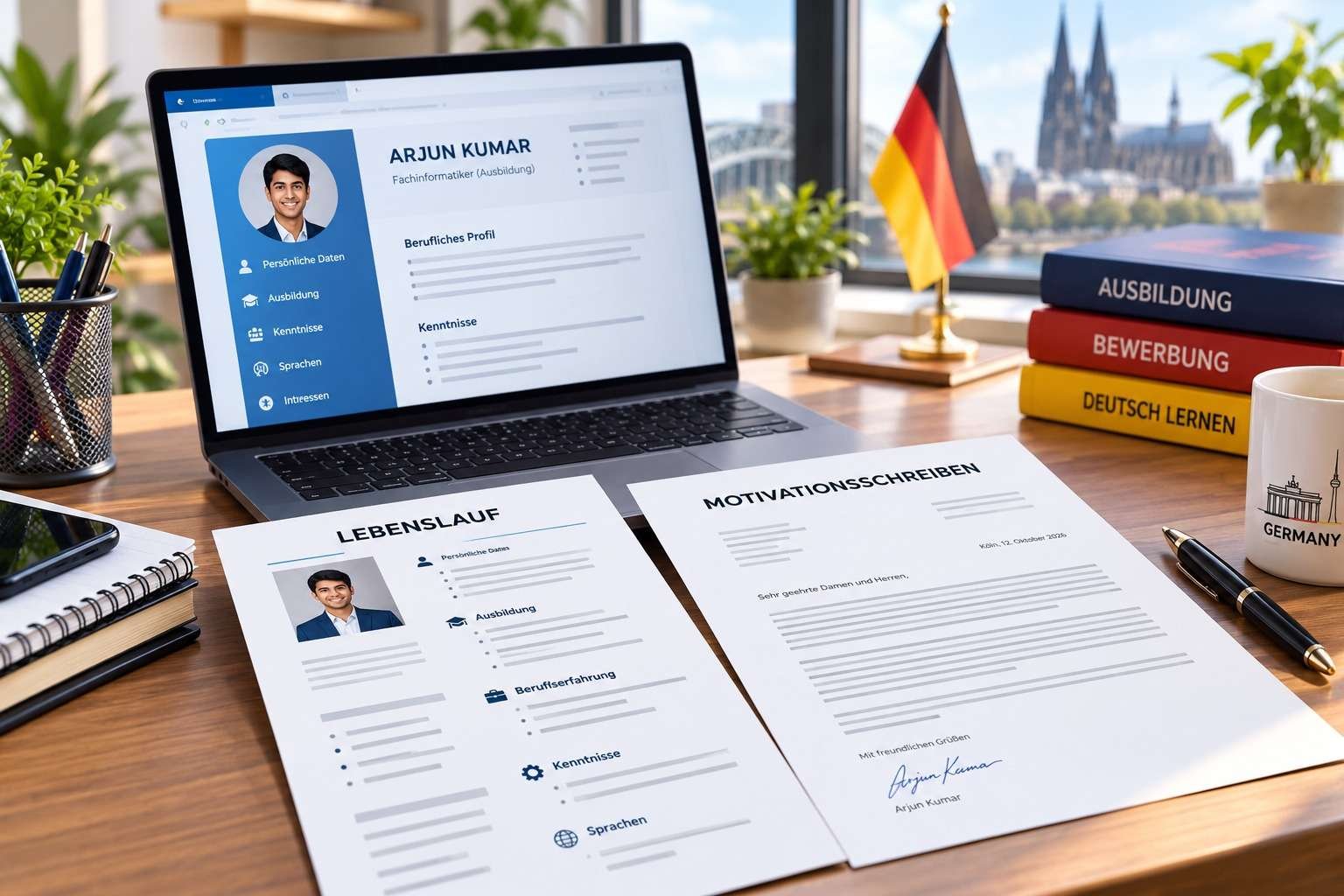
German CV & Motivation Letter

  • Prepare a professional German-style CV.
  • Create a customised motivation letter for the selected Ausbildung.
  • Adapt applications to individual employers rather than using one generic application.
7

Employer & Ausbildung Vacancy Search

  • Identify suitable Ausbildung vacancies.
  • Search across relevant German companies, hospitals, care institutions and other employers.
  • Match vacancies with the student's qualification and language level.
8

Application Management

  • Submit applications to suitable employers.
  • Track application status.
  • Manage deadlines and required documents.
  • Coordinate responses from employers.
9

Interview Preparation

  • Explain the German interview process.
  • Conduct mock interviews.
  • Prepare commonly asked questions and suitable answers.
  • Provide guidance on professional communication and German workplace culture.
10

Offer & Contract Verification

  • Help the student understand the Ausbildung contract.
  • Check important details such as training occupation, duration, remuneration, working hours and start date.
  • Explain important terms before the student accepts the contract.
11

Visa Guidance

  • Provide a complete checklist for the German Ausbildung visa.
  • Guide the student through the application process.
  • Assist with appointment preparation and documentation.
  • Review the visa file before submission.
12

Financial Planning

  • Explain expected costs in Germany.
  • Guide students regarding accommodation, insurance, travel and initial living expenses.
  • Explain how Ausbildung remuneration relates to living expenses and visa requirements.
13

Accommodation Guidance

  • Help students understand accommodation options.
  • Guide them regarding student residences, shared apartments and private accommodation.
  • Explain registration and other important formalities after arrival.
14

Pre-Departure Support

  • Provide a Germany pre-departure checklist.
  • Explain travel preparation, documents, insurance and essential items.
  • Brief students about German culture, workplace expectations and everyday life.
15

Arrival & Settlement Support

Guide students through important initial formalities such as:

  • Anmeldung (address registration)
  • Bank account
  • Health insurance
  • Tax-related formalities where applicable
  • Local transport
  • Communication / SIM

Provide guidance on settling into the new city.

16

Continuous Support After Arrival

  • Stay available during the initial period in Germany.
  • Help students understand Ausbildung-related procedures.
  • Guide them when they face administrative or practical issues.
  • Refer specialised legal, immigration or professional matters to qualified professionals where necessary.

Your Ausbildung Journey Starts With the Right Guidance.

From choosing the right career to preparing for your move to Germany, MissionGermany helps you navigate every important step with confidence.

Start Your Journey →

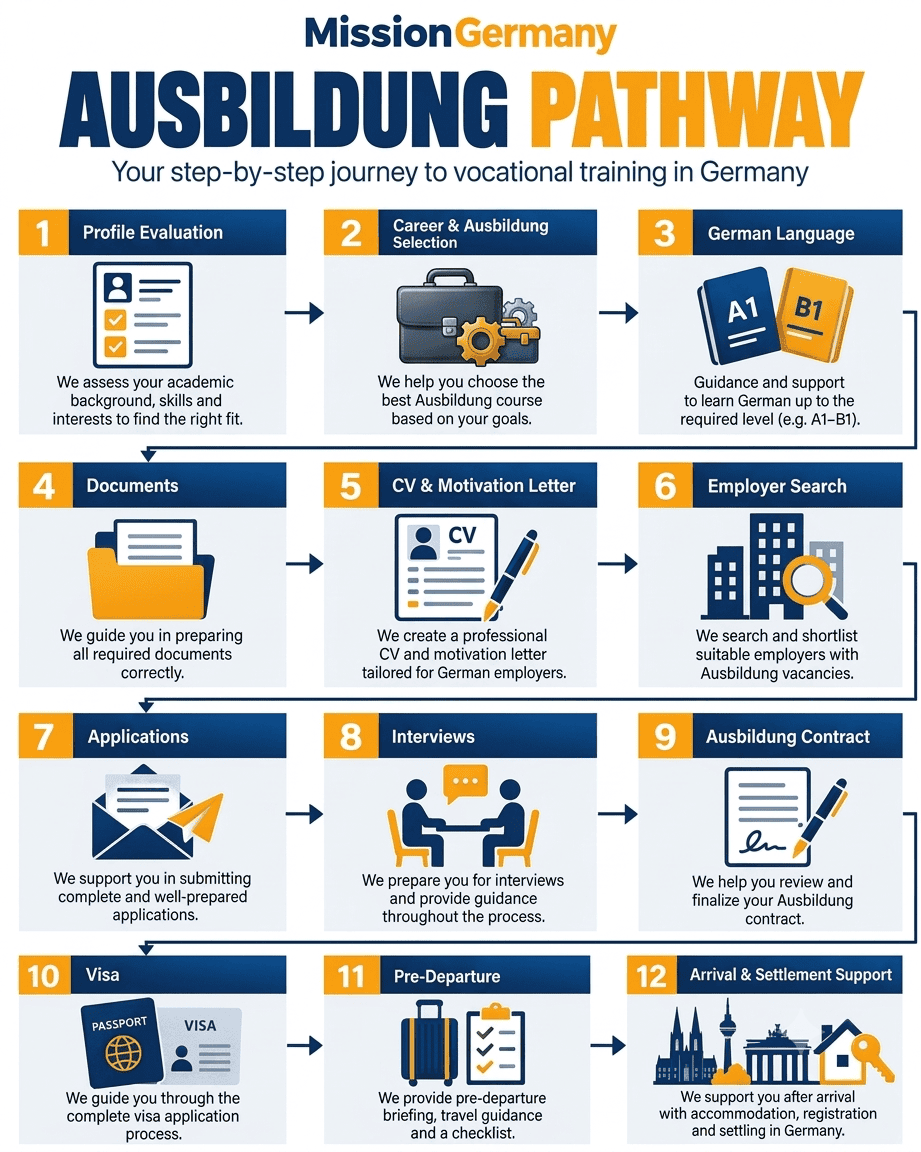
Complete Ausbildung Pathway

MissionGermany provides support throughout the complete Ausbildung journey:

1. Profile Evaluation
2. Career & Ausbildung Selection
3. German Language
4. Documents
5. CV & Motivation Letter
6. Employer Search
7. Applications
8. Interviews
9. Ausbildung Contract
10. Visa
11. Pre-Departure
12. Arrival & Settlement Support

This makes MissionGermany's role much broader than simply “finding an Ausbildung vacancy.” A successful service should focus on finding a suitable Ausbildung, a suitable employer, a properly prepared application, a compliant visa process and support until the student settles in Germany.
YOUR FUTURE STARTS HERE

Start Your Ausbildung Journey

Your career in Germany begins with the right profession, the right preparation, and the right guidance.

MissionGermany helps Indian students explore Ausbildung opportunities, understand the requirements, and plan their journey to Germany with confidence.

Ausbildung Frequently Asked Questions

Ausbildung is vocational education and training for a recognised occupation. In dual Ausbildung, you train in a company and attend vocational school at the same time. School-based Ausbildung takes place mainly at a vocational or specialised school, often with practical placements.

Dual/company-based Ausbildung is normally paid. The amount depends on the occupation, company, region, collective agreement and training year. School-based programmes are often unpaid, although important exceptions exist.

For covered dual vocational-training programmes beginning in 2026, the statutory minimum is €724 per month in the first year, €854 in the second, €977 in the third and €1,014 in the fourth. Actual salaries can be higher.

Not always. For a company-based vocational-training visa, the 2026 federal livelihood benchmark is €1,048 gross or €822 net per month. If the training salary is below this level, the applicant can normally cover the difference through a blocked account or a formal declaration of commitment.

B1 is the normal federal benchmark for a qualified vocational-training visa if the training institution has not already assessed the language level or no preparatory language course is planned. Some occupations and federal states require more. Nursing commonly requires B1 or B2 depending on the federal state.

Some employers may consider an applicant who is still progressing toward B1, and the German Missions in India currently mention at least A2 for professional training in general. However, B1 is the standard target recommended for most applicants because vocational school and examinations are in German and federal visa guidance normally uses B1.

There is no general legal maximum age for starting Ausbildung. Visa applicants aged 45 or above can face additional residence-law requirements related to income or retirement provision. The separate visa to search for an Ausbildung place has an age limit: applicants must be under 35.

Yes, depending on the occupation and employer. Many companies accept applicants after secondary school. The exact school requirement varies by occupation, and school-based programmes can require formal recognition of the foreign school certificate.

It may be possible for some occupations, especially where the employer accepts the applicant’s school level. There is no universal legal school qualification for every dual Ausbildung. The employer and vocational school requirements must be checked individually.

Not automatically for every dual Ausbildung. German law does not require a specific school qualification for all dual programmes, but the employer or school can request a recognised equivalent. School-based Ausbildung generally requires official recognition of the foreign school-leaving qualification.

Yes. A degree or previous work experience does not prevent you from starting vocational training. Your application should clearly explain why the chosen Ausbildung is a reasonable career path.

Depending on the occupation, vocational training usually takes about two to three-and-a-half years. Nursing professional training is normally three years full-time.

Ideally begin 12 to 18 months before the intended start date. Many programmes begin in August or September, and large employers often recruit early.

Not in every case. If a company-based training salary reaches the required visa livelihood level, a blocked account may not be necessary for that purpose. If the salary is lower, the shortfall can normally be covered by a blocked account or Verpflichtungserklärung. School-based trainees often need separate proof of funds.

A vocational-training residence permit permits a second job of up to 20 hours per week if it is independent of the Ausbildung. The trainee must still comply with employment law and the training contract.

The German Missions in India currently use the Consular Services Portal for vocational-training visa applications. You upload the required documents online and later attend an in-person appointment for biometrics, originals and fee payment.

As of 27 August 2026, the German Missions in India list the adult national-visa fee as €75, currently INR 8,400. The INR amount can change with the exchange rate and external service-provider fees can be additional.

Eligible applicants can use the training-place-search route under Section 17(1). You must be under 35, have B1 German, hold a qualifying school-leaving certificate and show at least €1,091 per month for living costs in 2026. The permit can be issued for up to nine months.

You can move into qualified employment. If you need time to find a suitable job, a residence permit for job seeking can be issued for up to 18 months after successful vocational training in Germany.

It can be part of a long-term residence pathway. Graduates of German vocational training who later hold an eligible skilled-worker residence permit for at least two years can qualify for a settlement permit under special rules if they also meet the other requirements, including pension contributions, B1 German and sufficient living space.

No. A training contract is a core requirement, but the visa authority still checks language, finances, insurance, documents and other legal requirements. A contract never guarantees visa approval.
🇩🇪 Why Germany?

One Destination. Endless Medical Opportunities.

Discover why Germany has become one of the world's preferred destinations for international doctors.

Germany Healthcare

Why Germany Needs
International Doctors

Germany continues to experience a significant shortage of healthcare professionals. Several factors contribute to this demand, including:

  • An ageing population with increasing healthcare needs.
  • Retirement of a large number of physicians.
  • Unequal distribution of doctors between urban and rural areas.
  • Growing demand for specialized medical services.

As a result, Germany has become one of the most attractive destinations for international doctors seeking postgraduate training and long-term career opportunities.

Residency Benefits

Why Choose Germany
For Residency Training?

Germany offers numerous advantages for international medical graduates:

  • Structured and internationally recognized specialist training.
  • Salaried positions in clinics and hospitals (approx. €4,800 – €5,500/month for beginners, increasing with experience)
  • Zero Tuition Fee as medical specialization is considered a Job.
  • High standards of healthcare and medical education.
  • Excellent work-life balance and quality of life with Five days working/ 40 hrs a week.
  • Extra duties are rewarded with extra payment.
  • Social Security, Health Insurance, and Pension.
  • Blue-card and Permanent Residency in 21 Months.
  • Desired branch with Direct Super-Specialization.
  • Flexibility of changing your choice of specialization during specialization training.

High Demand

Shortage of healthcare professionals.

€4,800 – €5,500

Beginner monthly salary during residency training.

Paid Program

Medical specialization is considered a Job.

21 Months

Permanent Residency pathway after eligibility.

Germany's Healthcare System Depends on International Talent

0
Foreign doctors currently practicing in Germany
0%
of all physicians in the country are foreign-trained (approx. 14–15%)

The number of foreign physicians working in Germany has increased steadily over the last decade. According to recent statistics from the German Medical Association (Bundesärztekammer), more than 65,000 foreign doctors are currently practicing in Germany, accounting for approximately 14–15% of all physicians in the country.

Doctors from European Union countries represent the largest group, but Germany also attracts thousands of physicians from non-EU countries, including India, Syria, Egypt, Russia, Ukraine and several other nations.

Germany's healthcare system is increasingly dependent on international medical graduates, making it one of the most welcoming destinations for doctors seeking residency and specialist training abroad.

Start Your Medical Career Journey in Germany

Germany welcomes skilled international doctors to join its world-class healthcare system. Discover opportunities, get expert guidance, and take the next step toward working in Germany.

Explore Doctor Opportunities

What Can a Foreign Doctor Do After Approbation in Germany?

Once you receive your Approbation (German Medical License), a world of opportunities opens up. Whether your goal is completing Postgraduate Medical Training (PG), joining Germany's leading hospitals, conducting medical research, or opening your own clinic, Germany offers excellent career growth, high salaries, and long-term professional stability.

Hospitals & Clinics

Work in leading university hospitals, private hospitals and specialty clinics across Germany.

Home Health Care

Provide personalized healthcare services for patients in their homes with flexible work opportunities.

Private Clinic

Build your own medical practice after fulfilling the required regulations and licensing process.

Medical Research

Join world-renowned research institutes and contribute to innovative healthcare discoveries.

Teaching

Become a faculty member in medical universities and mentor future healthcare professionals.

Public Health

Serve government agencies and healthcare departments to improve public health systems.

Health Insurance

Work with insurance organizations in medical evaluation, policy, and healthcare management.

Pharmaceutical Industry

Build a rewarding career in medical technology, clinical trials, or pharmaceutical companies.

What a Foreign Doctor Can Do After Approbation in Germany?

By being a doctor in Germany, you will open doors to a range of professional options like being an employee in hospitals, clinics, healthcare centres, geriatric care services, or home health care services, especially after completing PG in Germany after MBBS in India. You may even set up your private clinic. Other options include medical research, teaching, joining public health departments, health insurance organizations, or the private sector. You can even work as a scientist in medical technology or the pharmaceutical industry. Doctors in Germany have the best remuneration compared to any other profession, making postgraduate medicine Germany highly attractive. Germany remains one of the best countries for doctors seeking high-quality postgraduate training, attractive salaries, and long-term professional opportunities.

Hospitals & Clinics Home Health Care Private Clinic Medical Research Teaching Public Health Depts. Health Insurance Orgs. Pharmaceutical Industry

Types of Hospitals in Germany?

There are three types of Hospitals in Germany :

1

Public Hospitals

(Öffentliche Krankenhäuser) are owned and managed by municipalities, cities, or the federal states (Länder).

2

Charitable / Non-Profit Hospitals

(Freigemeinnützige Krankenhäuser) are operated by religious institutions or non-profit organizations, such as the German Red Cross.

3

Private Hospitals

(Privatkrankenhäuser) are owned by commercial companies and function as profit-oriented enterprises.

Requirements To Start Medical Residency In Germany (Zahnarzt Weiterbildung)

International doctors generally need :

The duration required for different levels of learning:

Mission Germany

  • A18 Weeks
  • A28 Weeks
  • B112 Weeks
  • B2.1, B2.216 Weeks
  • C1.1, C1.216 Weeks

In Germany

  • A18 Weeks
  • A28 Weeks
  • B18 Weeks
  • B2.1, B2.28 Weeks
  • C1.1, C1.28 Weeks

Goethe Institute (India)

  • A112 Weeks
  • A212 Weeks
  • B112 Weeks
  • B2.1, B2.224 Weeks
  • C1.1, C1.224 Weeks

Foreign Doctors In Germany?

The number of foreign physicians working in Germany has increased steadily over the last decade. According to recent statistics from the German Medical Association (Bundesärztekammer), more than 65,000 foreign doctors are currently practicing in Germany, accounting for approximately 14–15% of all physicians in the country.

Doctors from European Union countries represent the largest group, but Germany also attracts thousands of physicians from non-EU countries, including India, Syria, Egypt, Russia, Ukraine and several other nations.

Germany’s healthcare system is increasingly dependent on international medical graduates, making it one of the most welcoming destinations for doctors seeking residency and specialist training abroad.

What A Foreign Doctors Can Do After Approbation In Germany?

By being a doctor in Germany, you will open doors to a range of professional options like being an employee in hospitals, clinics, healthcare centres, geriatric care services, or home health care services, especially after completing PG in Germany after MBBS in India. You may even set up your private clinic. Other options include medical research, teaching, joining public health departments, health insurance organizations, or the private sector. You can even work as a scientist in medical technology or the pharmaceutical industry. Doctors in Germany have the best remuneration compared to any other profession, making postgraduate medicine Germany highly attractive. Germany remains one of the best countries for doctors seeking high-quality postgraduate training, attractive salaries, and long-term professional opportunities.

Types Of Hospitals In Germany?

There are three types of Hospitals in Germany :

  1. Public hospitals (Öffentliche Krankenhäuser) are owned and managed by municipalities, cities, or the federal states (Länder).
  2. Charitable or non-profit hospitals (Freigemeinnützige Krankenhäuser) are operated by religious institutions or non-profit organizations, such as the German Red Cross.
  3. Private hospitals (Privatkrankenhäuser) are owned by commercial companies and function as profit-oriented enterprises.

Requirements To Start Residency In Germany (Facharztweiterbildung)

International doctors generally need:

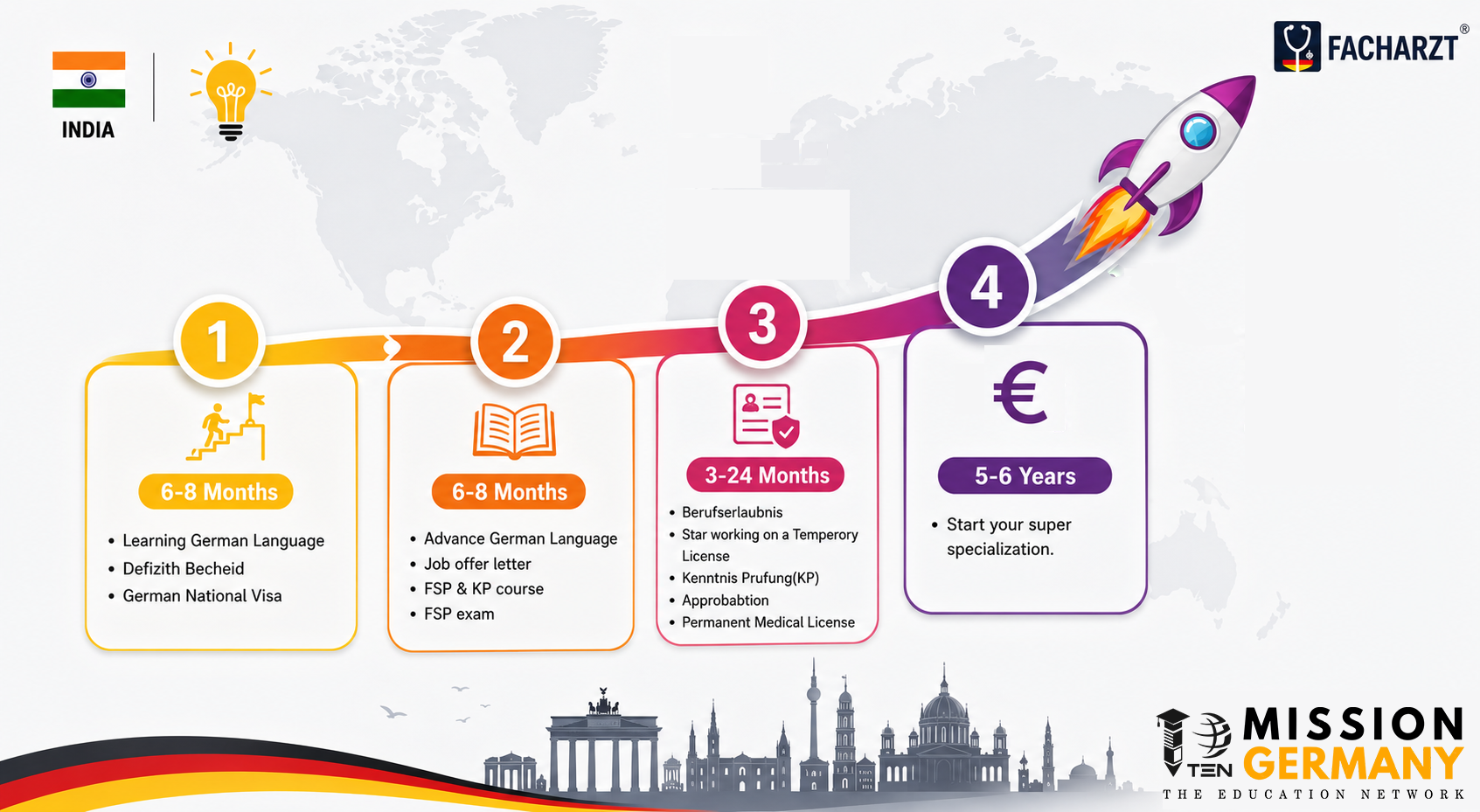
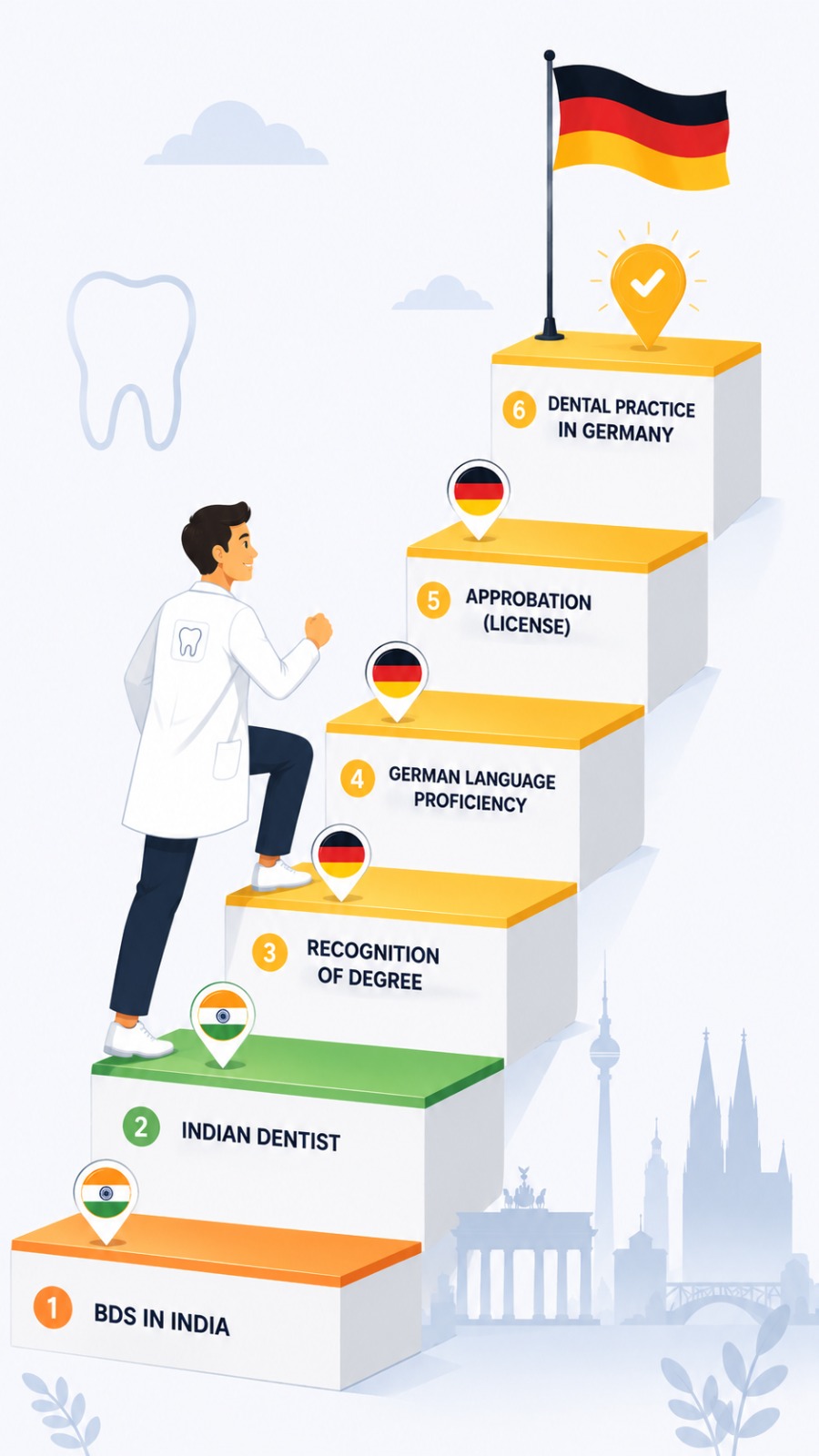
  1. Recognition of their medical degree.
  2. German language proficiency (usually B2 level).
  3. Passing the medical language examination (Fachsprachprüfung – FSP).
  4. Obtaining the German medical license (Approbation).
  5. Securing a residency position in a hospital or clinic.

Which German Federal State Is Best For The Medical Approbation?

It’s not about “Berlin or Munich” — it depends on which stage you are in and which challenge is most important for you.

We compare all 16 federal states of Germany for our doctors based on key factors such as:

  • Pass/fail rates from the latest medical chamber reports
  • Total Approbation processing time
  • Waiting time for KP exam appointments
  • Rules for issuing Berufserlaubnis (temporary license)
  • Frequency of Hearings (Anhörung / Defizitbescheid).
  • Policies for non-EU doctors
  • State-level funding and support programs
  • Salaries under TV-Ärzte contracts
  • Cost of living and rent in each state capital
This comparison is based on official sources, including:
  • State Medical Chambers (Ärztekammern)
  • Bundesärztekammer statistics
  • Regional authorities such as BLÄK, LÄK Baden-Württemberg, ZAABY, Bezirksregierung Münster, LSJV, and official chamber activity reports

🇩🇪 Medical PG in Germany

Ready to Start Your Medical Residency Journey in Germany?

Receive personalized guidance from eligibility assessment to Approbation licensing, German language training, hospital placements, visa support, and residency admission.

Free Eligibility Assessment
Language Training Support
Hospital Placement Assistance
End-to-End Approbation Guidance
350+

Doctors Guided

16 States

We work across Germany

Doctor led team

Experienced Medical Professionalse

MissionGermany Medical PG

Which German Federal State Is Best for the Medical Approbation?

It’s not about “Berlin or Munich” — it depends on which stage you are in and which challenge is most important for you.

We compare all 16 federal states of Germany for our doctors based on key factors such as:

  • Pass/fail rates from the latest medical chamber reports
  • Total Approbation processing time
  • Waiting time for KP exam appointments
  • Rules for issuing Berufserlaubnis (temporary license)
  • Frequency of Hearings (Anhörung / Defizitbescheid).
  • Policies for non-EU doctors
  • State-level funding and support programs
  • Salaries under TV-Ärzte contracts
  • Cost of living and rent in each state capital
  • FSP and Kenntnisprüfung fees

This comparison is based on official sources, including:

  • State Medical Chambers (Ärztekammern)
  • Bundesärztekammer statistics
  • Regional authorities such as BLÄK, LÄK Baden-Württemberg, ZAABY, Bezirksregierung Münster, LSJV, and official chamber activity reports
Medical Approbation Guide

Which German Federal State Is Best for the Medical Approbation?

It’s not about “Berlin or Munich” — it depends on which stage you are in and which challenge is most important for you.

We compare all 16 federal states of Germany for our doctors based on key factors such as:

Pass/fail rates from the latest medical chamber reports
Total Approbation processing time
Waiting time for KP exam appointments
Rules for issuing Berufserlaubnis (temporary license)
Frequency of Hearings (Anhörung / Defizitbescheid).
Policies for non-EU doctors
State-level funding and support programs
Salaries under TV-Ärzte contracts
Cost of living and rent in each state capital
FSP and Kenntnisprüfung fees
This comparison is based on official sources, including:
  • State Medical Chambers (Ärztekammern)
  • Bundesärztekammer statistics
  • Regional authorities such as BLÄK, LÄK Baden-Württemberg, ZAABY, Bezirksregierung Münster, LSJV, and official chamber activity reports
Medical Illustration

Fachsprachprüfung (FSP)

In English, Fachsprachprüfung translates to "Specialist Language Examination" or "Professional Language Examination". This is commonly used in Germany, to assess doctors with specialized German language proficiency, who obtained their degrees outside the country. It tests whether a medical professional can safely and effectively communicate in a clinical setting.

The exam does not test medical knowledge, only German medical language skills.

Doctor patient communication

Structure of the Fachsprachprüfung (FSP)

The exam has 3 parts, each lasting about 20 minutes :

1. Doctor–Patient Conversation (Anamnese)

You take the medical history from a patient. The patient is usually played by a physician who acts as a patient during the examination.

In this part, you should :

  • Build rapport with the patient.
  • Ask about symptoms, medical history, medications, and allergies.
  • Use patient-friendly language.
  • Show empathy and communicate clearly.

2. Medical Documentation (Arztbrief)

Based on the information obtained during the consultation, you write a medical report.

You should:

  • Document the history in a structured manner.
  • Use appropriate medical terminology.
  • Include the suspected diagnosis and further management.

3. Doctor–Doctor Communication (Arzt-Arzt Gespräch)

You present the case to another doctor using professional medical language.

In this part, you are expected to :

  • Summarize the patient's history and findings.
  • Discuss possible diagnoses and differential diagnoses.
  • Explain further investigations and treatment plans.
  • Answer questions from the examiner.

Difficulty Faced in Fachsprachprüfung (FSP)

  • Doctors who learn German only in their home country often struggle with local accents and hospital communication.
  • Doctors who learn German in Germany usually have a much higher success rate (over 90%).

A specialized medical German course can greatly improve chances of passing.

Who is Eligible to Take a Fachsprachenprüfung (FSP) Exam?

The doctor

  • Who has completed a B2/C1 level of the German language.
  • Have a valid medical degree.
  • Has a job contract / Einstellenzusage / Interest Letter from a clinic / Hospital in that state.

Then he/she can take this exam. This exam is taken by the respective state medical council of Germany where the doctor has the job contract and wants to practice after completion of all formalities.

Why and Where is the Fachsprachprüfung (FSP) Exam Taken?

The Fachsprachprüfung is part of the process to get the Approbation (permanent medical license) in Germany.

A doctor first chooses the German state (Bundesland) where they want to work. Then they submit their documents to the State Medical Council (Ärztekammer) for either:

  • Berufserlaubnis (temporary license), or
  • Approbation (full license)

After checking the documents and approving its recognition, the medical authority will schedule the Fachsprachprüfung (FSP) exam for you.

You cannot freely choose the exam centre. The exam is organized by the medical council (Ärztekammer) of the state where you applied.

Cost of the Fachsprachprüfung (FSP)

The exam fees are different in each German state and usually range between:

Around
€350

e.g. North Rhine Medical Council

Up to
€530

e.g. Bremen Medical Council

These fees can change over time, so it is important to always check the latest fee information from the responsible medical authority.

What is a Fachsprachkurs / C1 Medizin Kurs?

Preparation for the specialist language exam for doctors. This course helps in deepening of specialist language skills + medical subject (fundamentals of internal medicine)

Contents

  • Deepening and expansion of vocabulary from the field of human medicine
  • Colloquial expressions for body parts and diseases (in-depth)
  • Deepening of medical communication in the areas of anamnesis, formulation of findings, preparation of doctor's letters, conducting an informational interview
  • Communication with relatives, communication of negative messages
  • Linguistically confidently master conflict situations
  • Extension of the participial constructions
  • Extension of nominalization / verbalization

Goal

  • Be able to understand general and subject-related conversation, even if more complex language is used.
  • Be able to actively participate in specialist discussions in their own specialist area.
  • Can communicate with patients and relatives without any problems.

🇩🇪 Language Preparation

Begin Your C1 Medizin Language Preparation Today

Build the medical German language skills required to succeed in the Fachsprachenprüfung and confidently start your medical career in Germany.

Berufserlaubnis & Approbation

What is Berufserlaubnis?

Berufserlaubnis is a limited permission (2 Year) to work as a Doctor in Germany while your full license (Approbation) is still under process. This is acquired after passing the Fachsprachprüfung (FSP) exam.

It allows foreign-trained professionals to :

  • Work under supervision
  • Gain clinical experience in Germany
  • Start working earlier without waiting for full recognition

What is Approbation?

Approbation is the official German license to practice medicine (ärztliche Approbation). This is acquired after passing a knowledge test / Kenntnisprüfung (KP) or qualification assessment (Gleichwertigkeit).

It enables physicians to :

  • Work as a doctor in hospitals, clinics, or private practices.
  • Begin specialist training (Weiterbildung zum Facharzt).
  • Use the professional title "Arzt/Ärztin" in Germany.
  • Practice medicine permanently throughout Germany.

What is Kenntnisprüfung (KP) and How is it Conducted?

The Kenntnisprüfung (KP) typically takes place at a university hospital or an officially recognized teaching hospital in Germany.

The knowledge test is taken as an individual exam before three examiners. In addition to the subjects of surgery, internal medicine and general medicine, the following topics may be the subject of the examination:

Emergency Medicine Clinical Pharmacology/Pharmacotherapy Imaging Procedures Radiation Protection Legal Questions of the Medical Profession

The knowledge test is carried out in German and consists of two parts:

In the field of internal medicine or surgery, this takes place in a hospital. Under the supervision of a member of the examination board, you examine the patient assigned to you and collect the medical history. Finally, you prepare a report on the patient, which is also the subject of the theoretical examination.

This is followed by an oral-practical session, often held in small groups, in which the examiners ask in-depth questions based on clinical cases. The focus lies on internal medicine and surgery, but may also cover areas such as emergency medicine, pharmacology, and infectious diseases. This part usually lasts 60–90 minutes per candidate.

Bring to the Practical Exam:

  • A valid personal document (e.g. identity card, passport, residence permit)
  • Coat (white)
  • Stethoscope
  • Reflex hammer
  • Examination lamp
  • Paper and pen (to prepare the report)

What If You Fail in Kenntnisprüfung - Knowledge Test (KP)?

The knowledge test can only be repeated twice. Between the exams, a temporary license can be issued with restrictions for a maximum of 1 year if the examination board has determined that working as a doctor is possible without affecting the health of the patient.

Overview of the Fees for the Knowledge Test / Kenntnisprüfung

Baden-Württemberg€1,100
Bavariaapprox. €520
Berlin€540
Brandenburg€799
Bremen€730
Hamburg€900
Hessen€1,350
Mecklenburg-Vorpommern€640
Lower Saxony€830
Rhineland-Palatinate€1,100
NRW€1,050
Saarland€500
Saxony€850
Saxony-Anhalt€771
Schleswig-Holstein€400
Thuringia€450

Medical Specialist Training Duration in Germany

The following shows the minimum training duration (in months) required for different medical specialties in Germany.
Note: Requirements may vary slightly between different State Medical Associations (Ärztekammern).

Specialist: Anaesthetist60 months

Specialist: Ophthalmologist60 months

General Surgery24 + 48 months Vascular Surgery24 + 48 months Cardiac Surgery24 + 48 months Paediatric Surgery24 + 48 months Orthopaedic & Trauma Surgery24 + 48 months Plastic & Aesthetic Surgery24 + 48 months Thoracic Surgery24 + 48 months Visceral Surgery24 + 48 months

Specialist: Gynaecologist & Obstetrician60 months

Subspecialties:

Reproductive Medicine60 + 36 months Gynaecological Oncology60 + 36 months Perinatal Medicine60 + 36 months

ENT Specialist24 + 36 months

Specialist: Dermatologist60 months

General Internist / GP60 months

Internal Medicine Subspecialties:

Angiology72 months Endocrinology & Diabetology72 months Gastroenterology72 months Haematology & Oncology72 months Cardiology72 months Nephrology72 months Pneumology72 months Rheumatology72 months

Paediatrician60 months

Subspecialties:

Paediatric Haematology & Oncology60 + 36 months Paediatric Cardiology60 + 36 months Neonatology60 + 36 months Paediatric Neurology60 + 36 months

Specialist60 months

Specialist72 months

Specialist60 months

Specialist60 months

Psychiatrist60 months Forensic Psychiatry60 + 36 months

Specialist60 months

Radiologist60 months

Subspecialties:

Paediatric Radiology60 + 36 months Neuroradiology60 + 36 months

Specialist60 months

Specialist60 months

Specialist60 months

Important Note : Training durations are based on the German Medical Association (Bundesärztekammer) guidelines. Each federal state (Ärztekammer) may have slightly different requirements.

Advantages of Medical PG in Germany After MBBS in India

No Competitive Examination

Germany has qualifying German language exams and a Practical Exam, with a high % of success rate, unlike the USA and UK where competitive exams like USMLE, PLAB, etc. which have to be attempted.

Need for Health Care Practitioners

Doctors are in high demand in Germany, unlike the USA and UK. Owing to its strong economy and growing demand for healthcare professionals.

Guaranteed Settlement

Doctors working in Germany on temporary license (Berufserlaubnis) are eligible for a Blue Card. They can apply for a Permanent Residency in 21 months and a German citizenship in 6 years.

Internationally Recognized Degrees

Medical Specialization Degrees acquired in Germany have international recognition, offering universal prospects for employment and higher studies.

Regulated Residency Programs

Germany ensures an all-inclusive and uniform training experience through its well-structured residency programs, offering well-defined pathways for specialization.

Research Opportunities

Germany boasts of state-of-the-art medical research, ensuring PG students with cutting-edge research projects and alliances with leading industry experts.

To summarize, pursuing a Medical PG in Germany vis-à-vis the USA and UK provides a combination of fine-quality training, lower cost of living, and varied opportunities that make it a convincing choice for international medical graduates.

Make Your Mission Possible with MissionGermany

Your career, your choice — start your Medical PG in Germany journey today.

Get in Touch
Book Consultancy

Get Free Consultation

Please fill the form & we will contact you shortly.

Contact Form Main

✓

Thank You!

Your form has been submitted successfully.
We will contact you shortly.