
Introduction: Studying in Germany Without IELTS – Is It Possible?
Germany has quietly become one of the most popular places for international master’s students, and it’s easy to see why. Top universities, low tuition fees, lots of job opportunities, and a central spot in Europe make it a great choice. Every year, hundreds of thousands of students from around the world aim for German universities, hoping for a future with good education and real job chances.
But then comes the question that stops so many applicants in their tracks: Do I need IELTS to study in Germany?
It’s one of the most common worries students have, and for good reason. Getting ready for IELTS takes time, money, and a lot of effort. For many, it feels like an extra obstacle, especially if they’ve already studied in English for years. Some students can’t get to test centers, or are rushing to meet application deadlines.
Can I do masters without IELTS in Germany? — yes, you can. But there are certain conditions you need to meet, and knowing these rules can make the difference between a successful application and a rejected one.
This guide is here to explain things clearly. You’ll find out which universities and programs don’t need IELTS, what other proof of English they accept, which documents you can use instead, and how to find programs that match your background.
Whether you want to save money, are short on time, or just looking at your choices, by the end of this article, you’ll have a clear plan for applying for a master’s in Germany without needing to take the IELTS test.
Is IELTS Mandatory for Masters in Germany?
“Can I do masters without IELTS in Germany?” is probably the most common question students ask when planning to study here, and the answer is not just yes or no. It depends on the university, the program, and your own background. To see why this question matters so much, it’s helpful to first look at how much the number of international students in Germany has grown.
Germany’s Rising Appeal: International Enrolment 2015–2025
Germany has seen a near-unbroken upward trend in international student enrolment over the past decade. The table below shows just how significant that growth has been — and why IELTS policy has become such a key topic for the hundreds of thousands of students now applying each year.
| Year | Total Intl. Students | Master’s Students (Intl.) | Non-EU Master’s | Key Development |
| 2015 | 321,569 | ~74,000 | ~42,000 | Steady growth; Bologna reforms take effect |
| 2016 | 339,966 | ~80,000 | ~46,000 | India & China emerge as top-sending nations |
| 2017 | 358,895 | ~88,000 | ~51,000 | English-taught programs exceed 1,000 mark |
| 2018 | 374,582 | ~96,000 | ~56,000 | Uni-Assist expands MOI certificate review |
| 2019 | 400,734 | ~108,000 | ~63,000 | Record pre-pandemic international intake |
| 2020 | 368,721 | ~99,000 | ~57,000 | COVID-19 disrupts enrolment; online pivot |
| 2021 | 358,895 | ~97,000 | ~55,000 | Partial recovery; hybrid admissions normalize |
| 2022 | 404,776 | ~118,000 | ~70,000 | Post-pandemic surge; MOI widely accepted |
| 2023 | 432,000 | ~131,000 | ~79,000 | Highest recorded intake; IELTS waivers grow |
| 2024 | 448,000 | ~140,000 | ~86,000 | Flexible proof becomes admissions norm |
| 2025 | ~460,000* | ~148,000* | ~92,000* | Projected — DAAD estimate |
* 2025 figures are DAAD projections. Master’s and non-EU figures are rounded estimates from Destatis and Wissenschaft Weltoffen annual breakdowns. Source: DAAD Wissenschaft Weltoffen Reports 2015–2024.
As the numbers show, the number of international master’s students has more than doubled since 2015. Because of this growth, universities have made their admissions process simpler. Many now use a more flexible way to check English skills instead of always requiring IELTS.
General Language Requirements in German Universities
German universities offer programs in two primary languages: English and German. The language requirement you’ll face depends entirely on which type of program you choose.
For master’s programs taught in English, universities usually want proof that you can read, write, and speak English well enough for university studies. The most common tests are IELTS (usually a score of 6.0–7.0), TOEFL iBT (usually 80–100), and for programs taught in German, exams like TestDaF or DSH are needed.
These are just general rules. Each university decides its own minimum requirements, and some are more flexible than others about accepting different types of proof.
When IELTS Is Required
IELTS is more likely to be a strict requirement in some cases. Very competitive programs, like those at TU Munich, LMU Munich, or Heidelberg University, commonly have strict English rules because they get so many applications from around the world.
Programs in areas like medicine, law, or business may also need IELTS or TOEFL, especially if the course involves a lot of professional communication. If a program is very popular and gets thousands of applications, they usually set the same requirements for everyone to make the selection process easier.
When IELTS Is NOT Required
Here’s where things get interesting for many students. Many German universities, especially public ones with more open policies, let you skip IELTS if you can show your English skills in another way.
The most common way to skip IELTS is if you studied in English before. If you finished your bachelor’s degree (or most of it) at a university where classes were in English, many universities will accept this as enough proof. You usually show this with a Medium of Instruction (MOI) certificate from your old university.
Some universities also let you skip IELTS if you are a native English speaker or if English is your country’s official language. The main point: IELTS is not required everywhere in Germany, but you must provide real, clear proof of your English skills instead.
How to Study in Germany Without IELTS
Knowing that IELTS isn’t always needed is one thing, but applying without it means you need a clear plan. Here are the most practical ways students do this.
Medium of Instruction (MOI) Certificate
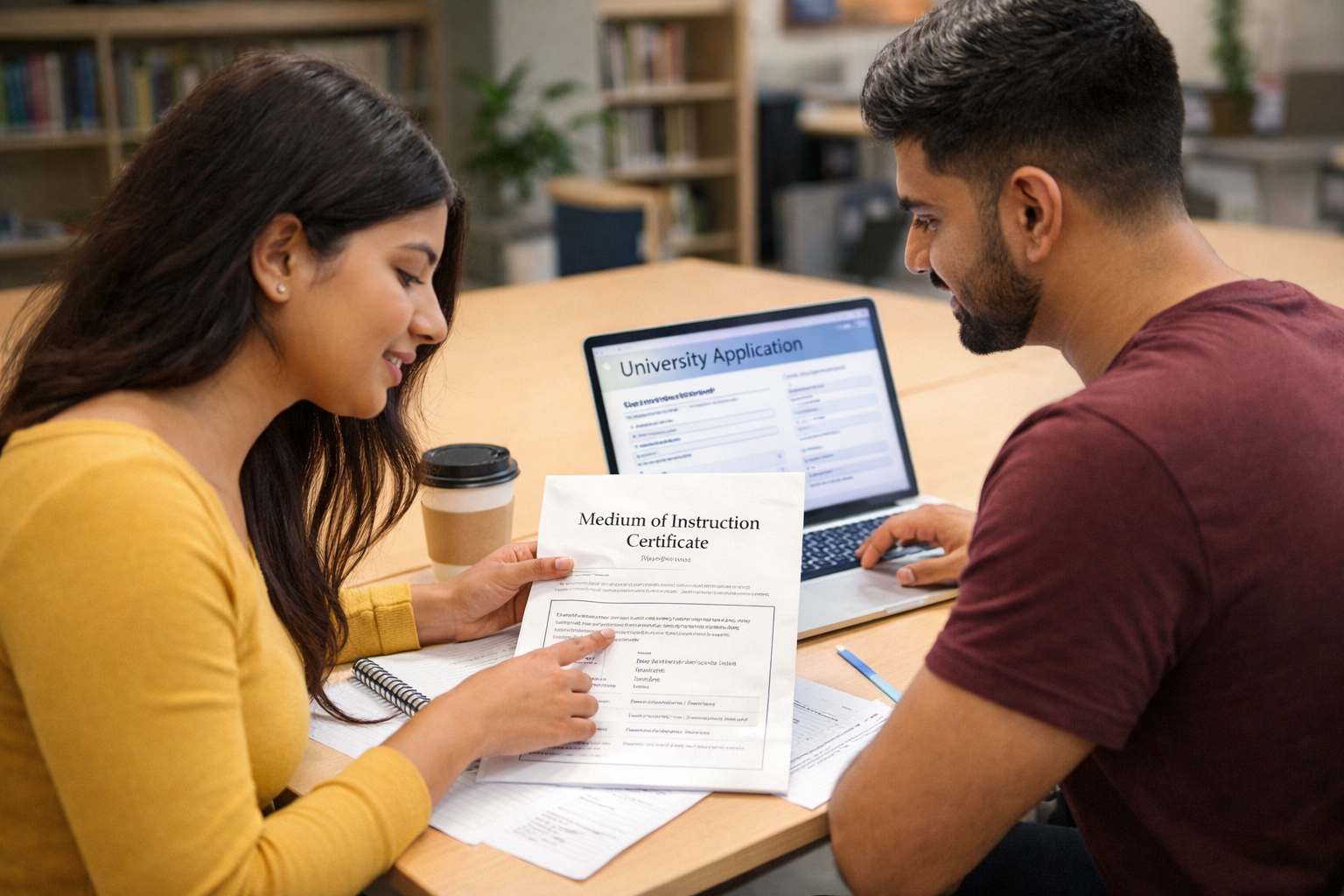
The MOI certificate is the most common alternative to IELTS for students applying to German universities. Simply put, it’s an official paper from your old university that says your classes were taught in English.
To get one, you need to ask your university’s registrar or international office for a Medium of Instruction Certificate. Make sure it is on official letterhead, stamped and signed by someone in charge (like the Dean or Registrar), and says how much of your coursework was in English — ideally, all of it.
Most German universities accept this document, especially if your whole bachelor’s degree was in English. However, not all universities accept MOI certificates from every school, so it’s a good idea to check with the admissions office before you apply.
The Rise of IELTS-Waiver Programs: A 10-Year Trend
If you’re still wondering whether can I do masters without IELTS in Germany is a question worth acting on, the data below should put that doubt to rest. The number of English-taught programs that accept other proof instead of IELTS has grown steadily over the past ten years.
| Year | English-Taught Programs | IELTS-Waiver Programs (Est.) | Waiver % | Key Policy Development |
| 2015 | ~1,050 | ~480 | ~45% | Early MOI waiver pilots at select universities |
| 2016 | ~1,180 | ~550 | ~47% | Uni-Assist formalizes MOI document review |
| 2017 | ~1,340 | ~640 | ~48% | DAAD expands English-taught program listings |
| 2018 | ~1,500 | ~730 | ~49% | Bologna standardization broadens flexibility |
| 2019 | ~1,720 | ~870 | ~51% | MOI widely recognized; online admissions grow |
| 2020 | ~1,800 | ~940 | ~52% | COVID accelerates flexible admission policies |
| 2021 | ~1,940 | ~1,010 | ~52% | Hybrid learning removes geographic barriers |
| 2022 | ~2,100 | ~1,120 | ~53% | Post-COVID intake recovery; Duolingo tested |
| 2023 | ~2,350 | ~1,280 | ~54% | Flexible English proof becomes near-standard |
| 2024 | ~2,540 | ~1,400 | ~55% | Private universities expand IELTS-free intake |
| 2025 | ~2,700* | ~1,500* | ~56%* | Projected — DAAD program database estimate |
* 2025 figures are projected estimates. IELTS-waiver program counts are approximations based on DAAD course database filters and university admission policy reviews. Source: DAAD Programme Database and Wissenschaft Weltoffen Reports 2015–2024.
The trend is clear: what started as a test at a few universities in 2015 is now a common practice by 2024. More than half of all English-taught programs in Germany now accept some kind of alternative English proof, and this number is expected to keep growing.
Alternative English Proficiency Tests
If you didn’t study fully in English before, you still have other options besides IELTS. TOEFL iBT is the most accepted alternative, and many German universities see it as equal to IELTS. A score of 80 or higher is usually good enough for most programs.
Cambridge English certificates (like B2 First or C1 Advanced) are also accepted by some universities, especially those that work with other European schools. The Duolingo English Test is not widely accepted in Germany yet, but a few universities and private schools are starting to accept it. Always check the university’s admissions page before you count on Duolingo being accepted.
Studying in German Language
If you are willing to learn German or already know the language well, choosing a master’s program taught in German means you don’t have to prove your English skills at all.
For German-taught programs, you’ll need to prove your German language skills instead. The standard certifications accepted are TestDaF (Test Deutsch als Fremdsprache), DSH (Deutsche Sprachprüfung für den Hochschulzugang), and Goethe-Zertifikat C1 or C2. Most programs require at least a B2 level, with many asking for C1.
This option means you need to spend more time learning German, but it gives you access to many more programs. It can also save you money, since most German-taught programs at public universities have little or no tuition fees.
List of German Universities That Accept Students Without IELTS
While rules change often, here is a general look at the types of schools that are known for being flexible about English requirements.
Public Universities
Several public German universities are known to accept other proof of English skills instead of IELTS. These include the University of Siegen, University of Kassel, University of Duisburg-Essen, and Hochschule Bremen, among others. These schools often accept MOI certificates or proof that you studied in English before.
However, university admission rules change every year. A university that accepted MOI certificates last year may have changed its rules this year. Always use any list you find online (including this one) as a starting point for your own research, not as a final answer.
Private Universities
Private universities in Germany are usually more flexible about admission requirements, including English skills. Schools like EU Business School, IU International University of Applied Sciences, and SRH University often look at the whole application and may consider interviews, grades, and work experience alongside or instead of test scores.
The trade-off is tuition fees. Unlike public universities which often charge little to no tuition, private universities in Germany can charge anywhere from €5,000 to €20,000 per year. Make sure the flexibility is worth the extra cost.
Important Disclaimer
No article, blog post, or admissions consultant — including MissionGermany, The Education Network — can give you a guaranteed list of universities that will accept you without IELTS. Policies update, programs get discontinued, and exceptions exist.
Always verify directly on the official university website or contact the admissions office before you submit your application. This one step can save you from rejection on a technicality.
Eligibility Criteria for Masters in Germany Without IELTS
Before you can confidently answer can I do masters without IELTS in Germany for your own situation, you need to understand the eligibility bar. Even without IELTS, there are clear requirements every applicant must meet.
Academic Requirements
You need a recognized bachelor’s degree in a related subject. German universities care about how your previous studies match the master’s program. For example, if you want to study computer science but your bachelor’s was in economics, you may have problems unless the program is open to students from different backgrounds.
For grades, most programs want at least a German 2.5 or higher (about a 3.0 US GPA or 60–65% in India). Top universities may want even better grades. ANABIN and DAAD have guidelines to compare international grades.
Language Proof Alternatives — Which One Is Right for You?
Not all types of English proof are accepted the same way by German universities. The comparison below helps you see which option matches your situation, budget, and the universities you want, so you can pick the best one before you apply.
| Proof Type | Accepted By | Difficulty | Approx. Cost (India) | Best For |
| IELTS Academic | Most German universities | Moderate | ₹17,000 – ₹18,500 | Students needing broadest acceptance |
| TOEFL iBT | Most German universities | Moderate | ₹17,000 – ₹19,000 | Students comfortable with computer-based test |
| MOI Certificate | Many public & private universities | Easy (admin only) | Free (from your university) | English-medium bachelor’s graduates |
| Cambridge C1/C2 | Select universities (esp. EU-partnered) | Moderate–High | ₹14,000 – ₹17,000 | Students with strong formal English training |
| Duolingo English Test | Limited (mainly private universities) | Easy | ~₹3,500 | Backup option; always verify acceptance first |
| German Proficiency (TestDaF / DSH) | All German-taught programs | High | ₹9,000 – ₹14,000 | Students pursuing German-medium programs |
| Native / Official English Country | All universities (automatic waiver) | N/A | No cost | Students from UK, USA, Australia, etc. |
Note: Costs are approximate and based on 2024 fee structures in India. Acceptance levels vary by university — always verify on the official admissions page. The MOI Certificate is free but must be issued on official university letterhead with clear language specifying English as the sole medium of instruction.
For most Indian students who finished a bachelor’s degree in English, the MOI certificate is the quickest, cheapest, and easiest option. TOEFL is the best backup if your chosen university has stricter rules.
Additional Documents
Besides your grades and language proof, most German master’s programs will also ask for a Statement of Purpose (SOP). This is a personal essay where you explain why you want to join the program, your academic background, and your career goals. Keep it transparent, honest, and specific to the program.
You will also need Letters of Recommendation (LORs), usually two or three, from professors or work supervisors who can talk about your academic skills and potential. A good CV or resume that lists your research, internships, and skills is also important for your application.
Step-by-Step Application Process Without IELTS
Applying to a German university without IELTS is mostly the same as any other international application, but there are a few extra steps. Here’s how to do it.
Step 1: Shortlist Universities
Start by finding programs that clearly say they accept other proof of English skills. Use the DAAD database (daad.de) to search for English-taught programs, then check each university’s website for its language rules. Look for expressions such as ‘MOI certificate accepted’ or ‘native English speakers do not need language tests.’
Make a balanced list of 6–10 universities, including some competitive programs and some safer choices.
Step 2: Prepare Required Documents
Collect all the required documents early. This is where most students without IELTS run into trouble — either missing the MOI certificate entirely or submitting one that isn’t specific enough. The table below gives you a full checklist of every document you need, where it is required, and which ones need extra care when you are not submitting an IELTS score.
| Document | Required For | Notes | Extra Care Without IELTS? |
| Academic Transcripts | University + Uni-Assist | Must be translated (English/German) and attested | No |
| Bachelor’s Degree Certificate | University + Visa | Original or notarized copy required | No |
| MOI Certificate | University (language proof) | Must clearly state 100% English-medium instruction | YES — critical document |
| Statement of Purpose (SOP) | University | Tailored to each program; mention English fluency evidence | Yes — mention language background |
| Letters of Recommendation (LORs) | University | 2–3 from professors or professional supervisors | No |
| CV / Resume | University | Highlight English-medium education and any relevant experience | No |
| TOEFL / Cambridge Score (if applicable) | University (alternative proof) | Only if MOI is not accepted by that university | Conditional |
| Passport Copy | University + Visa | Valid for at least 6 months beyond intended study period | No |
| University Admission Letter | Visa | Conditional or unconditional — both accepted for visa | No |
| Blocked Account (Sperrkonto) | Visa | Minimum ~€11,904 (2026 requirement); | No |
| Health Insurance Proof | Visa + University enrolment | Public or private — must be valid in Germany | No |
| Study Plan / Motivation Letter | Visa | Explains why Germany, why this program, career goals | No |
Rows highlighted in amber require extra care for applicants without IELTS. Always request your MOI certificate early — some university offices take 2–4 weeks to prepare it.
Step 3: Apply via Uni-Assist or Directly
Many German universities use a central application website called Uni-Assist for international applications. Uni-Assist checks your academic records to see whether they match German standards before sending your application to the university.
Not all universities use Uni-Assist — some accept direct applications through their own portals. Always check which system the university uses before applying, and be aware that Uni-Assist charges a processing fee per application.
Step 4: Attend Interviews (if required)
Some universities, especially for competitive or research programs, may invite selected applicants for an interview. This is sometimes used to check your English if you did not submit a standard test score. Be ready to talk clearly about your educational history, research interests, and why you chose Germany.
Step 5: Receive Admission Letter
Once you are accepted, you will get either a conditional or unconditional offer. A conditional offer means you are admitted only after you meet certain requirements, like sending your final grades or original degree certificate. An unconditional offer means you are fully admitted. Both can be used for your visa application, but unconditional is better.
Visa Requirements Without IELTS
Getting into a university without IELTS is one thing — but what about the German student visa? Here’s what you need to know.
Is IELTS Required for a German Student Visa?
No, IELTS is not officially required for a German student visa. The German embassy does not ask for an IELTS certificate as part of the visa application. However, visa officers may still check if you have enough language skills, especially during a personal interview at the embassy.
In practice, if you’ve been admitted to an English-taught program at a recognized German university, that admission letter itself serves as proof that you meet the institution’s language requirements.
Alternative Proof for Visa
Your visa application should include your university admission letter (which shows you meet the language requirement), your MOI certificate, and any other English documents you sent to the university. These together help the visa officer understand your language skills.
If you are asked about language proficiency at the embassy interview, clearly explain that your degree was fully in English and that the university accepted your MOI certificate instead of a standard test.
Tips to Strengthen Your Visa Application
Besides language documents, a strong student visa application must show that you can pay for your stay in Germany. The best way is to open a blocked account (Sperrkonto) with a trusted provider like Fintiba or Expatrio, and put in the minimum amount required by the German consulate.
A clear and detailed study plan, explaining why you chose Germany, the program, and how it fits your career goals, also helps with visa officers. Make sure all your documents are clear and match each other.
Advantages of Studying in Germany Without IELTS
- Saves time and money: Pursuing masters in Germany without IELTS means skipping months of test preparation and saving on exam fees — both of which can add up significantly.
- Faster application process: Without waiting for test results, you can apply sooner and maybe get accepted earlier.
- Easier for English-medium graduates: If you studied in English for three or four years, you shouldn’t have to prove it again with a timed test.
- More options than you might think: More German universities now accept MOI certificates and other proof, giving you more choices than before.
- Levels the playing field: Students from countries where English is not the main language, but who studied in English, now have a fairer chance to get into German universities.
Disadvantages and Challenges
- Limited university options: Not every university accepts alternatives to IELTS. You may have fewer programs to choose from and might have to pick a different school than you wanted.
- Risk of rejection if English proof is weak: If your MOI certificate is not clear or complete, your application can be rejected, even if your grades are good.
- Visa problems in rare cases: Sometimes, embassy officers ask for test scores even if the university accepted other proof. This does not happen often, but you should be ready just in case.
- Competitive disadvantage: In some programs, IELTS scores are used to rank applicants. Not having a score could put you behind others who do.
- Uncertainty in policies: Because university rules change often, students who use old information might send incomplete applications.
Common Mistakes Students Should Avoid
Most students who search “can I do masters without IELTS in Germany” are excited about the possibility — but excitement can lead to oversights. These are the most common errors to watch out for:
- Assuming all universities waive IELTS: This is the most common mistake. Just because one university accepts MOI certificates does not mean another will. Check each program separately.
- Submitting a weak MOI certificate: A generic letter that doesn’t clearly state English as the sole medium of instruction is often rejected. Get a strong, precise document from your registrar.
- Ignoring visa requirements: Students sometimes focus entirely on university admission and forget to prepare for the visa stage. Make sure your financial and language documents are in order for both.
- Not checking updated admission rules: University websites change their admission requirements frequently. Always check the official website for the latest rules, not last year’s version.
- Applying to too few universities: Without IELTS, you already have fewer choices. Applying to only two or three programs is risky. Apply to more to increase your chances.
Expert Tips from MissionGermany, The Education Network
At MissionGermany, The Education Network we’ve helped hundreds of students manage the German admissions process — including those who applied without IELTS. Here’s what consistently works:
- Apply to several universities: Don’t rely on just one program. Apply to 6–10 universities, including both competitive and easier options. This way, you have a better chance.
- Keep IELTS as a backup: If you have the time and money, think about preparing for IELTS anyway, even just a little. A good score can give you more choices and help with your visa if needed.
- Prepare for university interviews: Some programs have informal English interviews. Practice talking clearly about your academic interests, goals, and why you chose Germany. First impressions are important.
- Learn basic German for better integration: Even if your program is fully in English, knowing some German (A2–B1 level) makes daily life in Germany much easier and can impress visa officers and admissions staff.
- Work with a reliable advisor: Applying to German universities without IELTS can be confusing. A good advisor who knows the rules can help you avoid expensive mistakes.
Data Sources & References
All statistical data used in this article is drawn from the following official and authoritative sources. We strongly encourage students to consult these directly for the most current figures, as enrolment data and program policies are updated annually.
- DAAD (Deutscher Akademischer Austauschdienst) — Wissenschaft Weltoffen Annual Reports (2015–2024). Primary source for international student enrolment data. Available at: www.wissenschaft-weltoffen.de
- Destatis (Federal Statistical Office of Germany) — Higher Education Statistics. Detailed breakdowns by nationality, level, and subject. Available at: www.destatis.de
- DAAD Course Database — English-Taught Programs in Germany. Official searchable database of all English-taught degree programs. Available at: www.daad.de/en/study-and-research-in-germany/courses-of-study-in-germany
- Hochschulkompass (German Rectors’ Conference — HRK). Lists all accredited German institutions and current admission requirements. Available at: www.hochschulkompass.de
- Uni-Assist e.V. — Annual Application Processing Reports. Documents application volumes and credential verification trends. Available at: www.uni-assist.de
- German Federal Foreign Office — Student Visa Requirements. Official documentation on the German student visa process. Available at: www.auswaertiges-amt.de
- ANABIN Database (KMK — Standing Conference of the Ministers of Education). Official reference for evaluating international academic qualifications in Germany. Available at: anabin.kmk.org
Note: Where exact annual figures were unavailable, estimates are derived from trend interpolation across published DAAD and Destatis reports. Figures marked (*) are DAAD projections for 2025 and should be treated as indicative. IELTS-waiver program counts are approximations based on DAAD course database filters and university admission policy reviews — not an official DAAD metric.
Conclusion: Should You Apply Without IELTS?
If you’ve read this far, the short answer to “can I do masters without IELTS in Germany” is yes — but only if you plan carefully, have strong documents, and are realistic about your university choices.
Applying without IELTS is best if your whole bachelor’s degree was in English, your university is recognized and can give you a good MOI certificate, and you are flexible about which universities and programs you choose.
On the other hand, if you have the time and money, taking IELTS, even as a backup, gives you many more choices. A good IELTS score opens more programs and makes your visa application stronger.
The main point: don’t let IELTS stop you from going to Germany. Look at your options, get your papers ready, and apply with a plan. The chance is real — you just need the right help to succeed.
Ready to take the next step? MissionGermany, The Education Network is here to help.
FAQs – Masters in Germany Without IELTS
Can I study in Germany without IELTS and TOEFL?
Yes, it’s possible, but you need another way to prove your English skills. The most common option is a Medium of Instruction (MOI) certificate from your old English-medium university. Some universities also do interviews to check your English. Still, not many programs accept no test scores at all, so you will have fewer choices.
Is MOI accepted everywhere in Germany?
No, not everywhere. Many universities accept MOI certificates, but some only accept IELTS or TOEFL. Always check the official university admissions page before you apply. Even within the same university, some programs may accept MOI while others do not.
Can I get a visa without IELTS?
Yes. IELTS is not required for a German student visa. Your university admission letter is usually enough to show your language skills. Still, it’s a good idea to bring your MOI certificate and any other language documents to your visa interview, just in case.
Which courses are easier to get without IELTS?
STEM fields (like engineering, computer science, and data science) and applied sciences usually have more flexible language rules than subjects like humanities, business, or social sciences. Programs at smaller universities or universities of applied sciences are also usually more flexible than those at big research universities.
Do German universities accept Duolingo?
A small but growing number of German universities now accept the Duolingo English Test, but it is not widely accepted yet. Private universities are more likely to accept it than public ones. If you want to use Duolingo, always check with the university first before taking the test. Don’t assume it will be accepted everywhere.
Let MissionGermany, The Education Network Guide Your Journey
Figuring out if you need IELTS, which universities to choose, and how to make a strong application can feel overwhelming, especially since rules keep changing and every university has different requirements.
That’s exactly what MissionGermany, The Education Network is here for.
We offer personal counselling sessions where our advisors look at your educational history and help you find universities that fit you, including those that accept alternatives to IELTS. We help you make your university list, write a strong SOP, prepare your documents for Uni-Assist, and guide you through every step of the visa process.
Whether you are just starting to think about Germany or are ready to apply right now, our team has the experience and local knowledge to help you secure your masters in Germany with the best possible chance of success. Get in touch with MissionGermany, The Education Network today — and let’s build your path to Germany together.