An Extensive Guide for Indian Doctors | MissionGermany

Introduction to Medical PG in Germany
For Indian doctors thinking about working in another country, Germany has become a very popular choice for further medical training. This is because Germany offers organised specialist training, good salaries while you are training, no entrance exams, and the chance to work in a top-quality healthcare system.
Yet despite growing interest, many Indian medical graduates begin this journey without a clear understanding of what the process actually involves — particularly in terms of time commitment.
Postgraduate medical training in Germany is called Weiterbildung and leads to becoming a Facharzt, which means specialist doctor. Unlike in India, where you have to pass exams for PG, in Germany, all training happens in hospitals. Doctors learn by working, are hired as staff, get supervision, and are paid from the start.
Usually, medical PG in Germany takes 5 to 6 years of full-time hospital work. Before starting, Indian doctors often spend another 1 to 2 years getting ready by learning German, getting their degree accepted, and passing the required medical language test.
This article breaks down everything you need to know — training duration by speciality, how it compares to India, the USA, and the UK, what affects your timeline, and how to plan your path efficiently.
Understanding the Medical PG Structure in Germany
Before figuring out how long postgraduate training takes, it is important to know how the system works. The German way of medical education is quite different from what Indian doctors are used to, so understanding these differences early can help avoid confusion later.
What Is “Facharzt” Training?
The term Facharzt is central to understanding medical PG in Germany. Translated literally, it means “specialist doctor.” Earning the Facharzt designation is the primary goal of postgraduate medical training in Germany, and it is the equivalent of becoming a recognised specialist in your chosen field.
In India, postgraduate degrees like MD or MS are given by universities and controlled by the National Medical Commission. In Germany, specialist qualifications are managed by the Ärztekammer, which is the local medical council. Each of Germany’s 16 states has its own Ärztekammer. The training is mostly the same everywhere, but there can be small differences in requirements between states.
The Facharzt system includes more than 50 medical specialities, such as Internal Medicine, General Surgery, Psychiatry, Radiology, and Neurology. Each speciality has a set of training rules that say how long is medical PG in Germany for that field, what skills you need to learn, and what procedures you must do before you can take the specialist exam.
How Medical PG Training Works in Germany
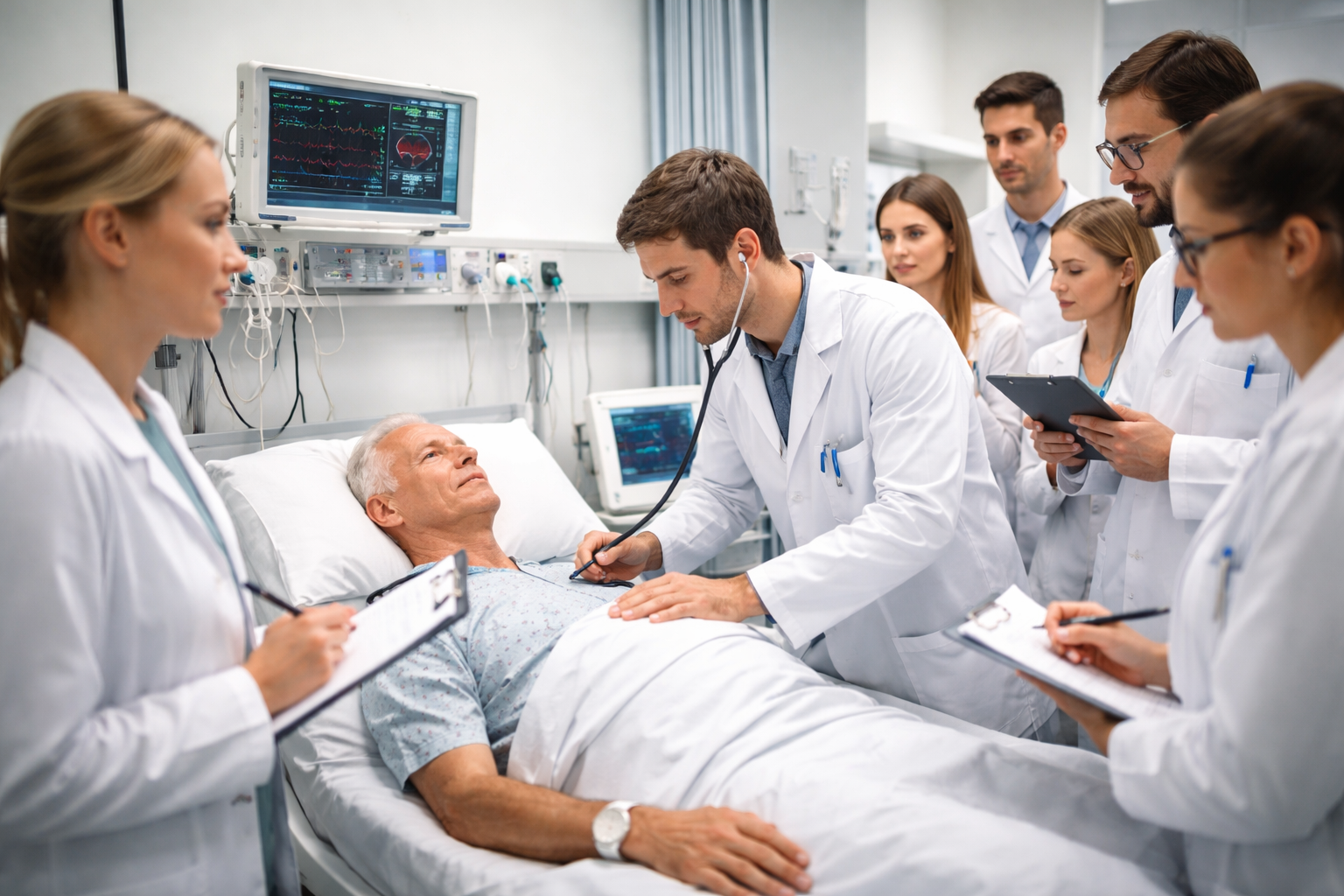
In Germany, all postgraduate training happens in hospitals. There are no classroom lessons, university exams, or semesters. Doctors in training work as hospital staff, see patients every day, do medical procedures, and slowly build up their specialist skills with guidance from senior doctors.
Training is supervised by an experienced doctor who is officially allowed to train junior doctors in a certain speciality. This supervisor guides your progress, checks off your completed skills, and confirms when you are ready for the Facharzt exam.
Progress in postgraduate training depends on the skills you learn, not just on how long you train. Each speciality has a minimum time you must spend, but you also have to show you have learned the needed skills, done the required number of procedures, and met the standards set by the Ärztekammer.
How Long Does Medical PG Take in Germany?
Most specialities need 5 to 6 years of full-time hospital training. Surgical specialities usually take 6 years. Some very specialised fields may need extra training after you become a Facharzt.
Average Duration of Medical PG Programs
Most Facharzt programs require at least 5 years of training. This does not include the time spent getting ready, like learning German, getting your degree accepted, and passing the medical language exam. For most Indian doctors, this preparation takes another 1 to 2 years before starting residency.
Duration Based on Medical Speciality
| Specialty | Approximate Duration |
| Internal Medicine | 5 Years |
| General Surgery | 6 Years |
| Pediatrics | 5 Years |
| Anesthesiology | 5 Years |
| Radiology | 5 Years |
| Psychiatry | 5 Years |
| Orthopedics | 6 Years |
| Family Medicine / General Practice | 5 Years |
Why Duration May Vary Between Doctors
Recognition of Previous Work: Doctors who have already done organised postgraduate training in India might get some of that experience counted by the Ärztekammer. If accepted, this can shorten the training time by up to one year.
Training Breaks: If you take time off for reasons like maternity leave, illness, or personal matters, your training will take longer. German law protects doctors in these cases, but you usually have to make up for the time missed.
Part-Time Training: In Germany, doctors can do their postgraduate training part-time. If you train at half-time, it will take twice as long to finish the program.
Changing Hospitals or Departments: Moving to a different hospital is common and can be helpful for your career. However, you must keep your training records up to date and make sure your new hospital accepts your previous training.
Duration of Popular Medical Specialisations in Germany
Internal Medicine (Approx. 5 Years)
Internal Medicine (Innere Medizin) is one of the most popular specialisations among Indian doctors. The training spans 5 years and covers cardiology, gastroenterology, nephrology, endocrinology, and general internal medicine. Trainees manage a wide range of acute and chronic conditions and may choose further subspecialty training, such as cardiology or gastroenterology, after certification.
General Surgery (Approx. 6 Years)
General Surgery (Allgemeinchirurgie) is one of the tougher specialities, with 6 years of training. You start by helping with surgeries and later handle more difficult cases on your own. Trainees must do a set number of surgeries in areas like abdominal, trauma, and emergency surgery.
Paediatrics (Approx. 5 Years)
Paediatrics (Kinder- und Jugendmedizin) takes 5 years of training and covers all areas of child and teen healthcare, from newborn care and child development to emergency care for children. After finishing, you can do extra training in areas like children’s heart care or newborn care.
Anesthesiology (Approx. 5 Years)
Anesthesiology (Anästhesiologie) is very popular with Indian doctors in Germany because there are many jobs and good pay. Training is 5 years and includes working in intensive care, learning pain control, managing breathing, and handling difficult situations during surgery.
Radiology (Approx. 5 Years)
Radiology (Radiologie) training takes 5 years and covers all main types of medical imaging, such as X-ray, ultrasound, CT, MRI, and special procedures using imaging. There is more demand for radiologists in Germany because there are not enough specialists in hospitals and clinics.
General Medicine / Family Medicine (Approx. 5 Years)
Family Medicine (Allgemeinmedizin) training is 5 years and includes time in hospitals and in approved general practice clinics. For Indian doctors who like working in the community, Family Medicine is a good way to build a long-term career in Germany, including the chance to run your own clinic.
Is Medical PG in Germany Faster Compared to Other Countries?
Germany vs India
In India, postgraduate medical training like MD or MS usually takes 3 years after passing the tough NEET-PG exam. But many doctors spend 2 to 4 years preparing just to get a PG seat. When you add this time, the total is often similar to the German path. In Germany, doctors are paid during training and do not pay tuition fees.
Germany vs USA
In the USA, you must pass the USMLE exams (Steps 1, 2, and 3), finish a residency (3 to 7 years), and often do extra training. The whole process often takes more than 8 to 10 years. In Germany, there are no entrance exams, and the training usually takes 5 to 6 years, making it a more straightforward and predictable way to become a specialist.
Germany vs UK
In the UK, postgraduate training starts with a 2-year Foundation Programme, then Core Training and Higher Speciality Training, which can take 8 to 10 years in total. Germany’s Facharzt training has a set timeline and no competitive exams between stages, so it is a faster way to become a specialist.
Can the PG Duration Be Reduced?
Recognition of Previous Experience
The Ärztekammer can accept some of your previous clinical training from outside Germany. If you have finished an MD in India, you can ask for part of your training to count towards your German Facharzt training. Usually, this can shorten your training by 6 months to 1 year, but you need to provide detailed proof of your past training.
Transfer of Training Between Hospitals
It is allowed and common to change hospitals during postgraduate training. The time you have already trained usually counts if you have the right paperwork and the new hospital’s Ärztekammer accepts it. If there are gaps between jobs or missing documents, you might lose some training time.
Accelerated Training Possibilities
Doctors who do very well, keep good records, and work in hospitals with organised training can finish in the minimum required time without delays. Picking a hospital with a good training program and helpful supervisors is important.
Work Schedule During Medical PG in Germany
Working Hours of PG Doctors
German law sets the normal working week for doctors at 40 hours, with a legal maximum of 48 hours including overtime. Most residency jobs have regular day shifts, plus some night and weekend shifts. Night shifts are paid extra or you get time off instead.
Salary During PG Training
Doctors are fully employed and paid throughout their training. Salaries are governed by collective wage agreements under the TV-Ärzte (Tarifvertrag für Ärzte). The table below shows how starting resident (Assistenzarzt) salaries have grown from 2015 to 2025, based on Marburger Bund and TV-Ärzte tariff data:
| Year | Starting Monthly Gross (Yr 1 Resident) | Key Development |
| 2015 | ~€3,800 – €4,000 | TV-Ärzte/VKA tariff baseline |
| 2016 | ~€3,900 – €4,100 | Incremental tariff revision |
| 2017 | ~€4,000 – €4,200 | Marburger Bund wage agreement |
| 2018 | ~€4,200 – €4,500 | Notable pay increase — approx. 3% |
| 2019 | ~€4,400 – €4,600 | Continued tariff progression |
| 2020 | ~€4,700 – €4,900 | New TV-Ärzte/VKA agreement signed |
| 2021 | ~€4,900 – €5,100 | Post-COVID recognition of healthcare workers |
| 2022 | ~€5,000 – €5,200 | Inflation-linked tariff adjustment |
| 2023 | ~€5,100 – €5,400 | Marburger Bund 2023–24 agreement |
| 2024 | ~€5,300 – €5,600 | Updated VKA scale effective April 2024 |
| 2025 | ~€5,500 – €5,800 | Current scale — approx. 44% higher than 2015 |
Source: Marburger Bund, TV-Ärzte (Tarifvertrag für Ärzte), VKA collective agreements 2015–2025. Figures represent the approximate gross base salary for Year 1 residents in municipal hospitals. University hospital (TdL) rates are typically 5–8% higher. Actual take-home pay after taxes and social contributions is approximately 35–42% lower.
Disclaimer: All figures are approximate and compiled from publicly available reports. Readers are advised to verify current rates directly with Marburger Bund or the relevant Ärztekammer before making financial decisions.
Work-Life Balance for Doctors in Germany
German law gives postgraduate doctors at least 30 days of vacation each year. Overtime is paid, or you get extra time off. For Indian doctors coming from busy hospitals, this organised system helps both their career and their personal life.
Key Requirements to Start Medical PG in Germany
Medical Degree Recognition
Indian medical degrees (MBBS) are not automatically accepted in Germany. To get your degree recognised, you must send your certificates, transcripts, and internship records to the right state office, usually the Landesprüfungsamt or Ärztekammer. If there are big differences, you may have to take a knowledge test.
German Language Requirements
Most hospitals and authorities need you to have at least the C1 level of German to work as a doctor. Besides general language skills, you must show you can communicate in medical German by passing the Fachsprachprüfung (FSP), a required medical language test. For most Indian doctors, reaching this level takes 12 to 24 months.
Medical License (Approbation or Temporary License)
To practice medicine in Germany, a doctor must hold either the Approbation — the full, permanent medical license — or a Berufserlaubnis, a temporary, limited license. Most Indian doctors begin their careers on a Berufserlaubnis while the full Approbation is being processed. The process can take several months and should be initiated well in advance.
Step-by-Step Timeline for Starting PG in Germany
Step 1: Learn the German Language
Starting from no prior knowledge, most dedicated learners reach B2 level in 12 months and C1 level in 18 to 24 months, if they study regularly at good language schools that focus on medical German.stitutes with a focus on medical German.
Step 2: Apply for Degree Recognition
While learning German, doctors should also start getting their degree recognised. This means collecting your academic papers, getting them officially stamped and translated, and sending them to the right state office. This usually takes 3 to 6 months.
Step 3: Pass the Medical Language Exam (FSP)
The Fachsprachprüfung checks your ability to talk with patients and other doctors in German, using practice cases and paperwork. Good preparation is important because the FSP tests both your language and your medical knowledge.
Step 4: Apply for Hospital Jobs
Once you have your language certificate and your degree is recognised, you can start applying directly to hospitals for residency jobs. Having a good CV and cover letter in German helps a lot in securing a hospital position and obtaining the necessary medical license. The formal Facharzt training period begins. From this point, the timeline to specialist certification is 5–6 years, depending on the chosen speciality — which answers the core question of how long is medical PG in Germany once the preparatory phase is complete.
Challenges International Doctors May Face
Language and Communication Barriers
Even doctors who have passed the FSP and have C1 German often find that talking with patients and staff in real hospital situations is harder than in exams. Most Indian doctors say it takes 6 to 12 months of working in a German hospital to become truly comfortable with clinical German.
Adapting to the German Healthcare System
German hospitals follow set rules, need detailed paperwork, and work in teams, which can be very different from what Indian doctors are used to. You will also need to get used to electronic records, standard ways of handing over patients, and getting patient consent.
Cultural and Workplace Differences
In Germany, people value being on time, speaking directly, and keeping work relationships professional. There are ranks, but they are usually less strict than in many Indian hospitals. Feedback is given honestly, and doctors are expected to think and act independently.
Benefits of Doing Medical PG in Germany
No Entrance Exams for Residency
One of the biggest benefits for Indian doctors is that there are no entrance exams for postgraduate training in Germany. There is nothing like NEET-PG. Hospitals hire doctors based on their qualifications, German language skills, and how well they suit the job, so you do not have to spend years preparing for exams.
Paid Training with a Good Salary
Postgraduate training in Germany is paid. Doctors get a good salary from their first day of residency, with no tuition fees or extra costs. This is a big change for Indian doctors who have already spent a lot on their education.
High-Quality Healthcare System
Germany is known for having one of the best health care systems in the world. Training here lets doctors use advanced medical tools, follow proven treatment methods, and keep learning. The experience you get during a German residency is respected all over the world.
Opportunities for a Long-Term Career in Europe
Finishing your Facharzt training in Germany lets you work not just in Germany but also in other European Union countries. Because EU countries accept each other’s medical qualifications, a German specialist can work in places like Austria, Switzerland, and the Netherlands, giving you great career options.
Germany’s Healthcare Demand & Doctor Shortage Trend (2015–2025)
To fully appreciate why Germany actively recruits foreign doctors, it is important to understand the scale and trajectory of its physician shortage. The data below, compiled from Bundesärztekammer (German Medical Association), WHO, and KBV (National Association of Statutory Health Insurance Physicians) reports, illustrates the growing gap between healthcare demand and available doctors over the past decade.
| Year | Total Employed Doctors (approx.) | Estimated Doctor Deficit | Foreign Doctors in Germany | Key Context |
| 2015 | ~357,000 | ~5,000–8,000 | ~28,000 | Rising GP retirement wave begins |
| 2016 | ~364,000 | ~8,000–10,000 | ~31,000 | Rural shortages become critical |
| 2017 | ~371,000 | ~10,000–12,000 | ~35,000 | KBV warns of imminent GP crisis |
| 2018 | ~378,000 | ~12,000–15,000 | ~38,000 | Foreign doctor recognition fast-tracked |
| 2019 | ~385,000 | ~15,000–18,000 | ~42,000 | 50% of GPs now over age 50 |
| 2020 | ~392,000 | ~20,000–25,000 | ~49,000 | COVID-19 exposes workforce gaps |
| 2021 | ~400,000 | ~25,000–30,000 | ~54,000 | 40% of pandemic-vacated posts unfilled |
| 2022 | ~407,000 | ~30,000–35,000 | ~58,000 | 1 in 4 doctors consider leaving profession |
| 2023 | ~415,000 | ~35,000–40,000 | ~62,000 | 12% of all doctors in Germany are foreign |
| 2024 | ~420,000 | ~40,000–45,000 | ~66,000 (est.) | Hospital Reform 2025 announced |
| 2025 | ~425,000 (est.) | ~45,000–50,000 | ~70,000 (est.) | Robert Bosch: 11,000 GP deficit by 2035 |
Data References: Bundesärztekammer Ärztestatistik 2015–2024, KBV Bedarfsplanung reports, WHO World Health Statistics 2025, Destatis, Robert Bosch Stiftung healthcare workforce projections. Deficit figures represent estimated unfilled positions across hospital and outpatient settings. Foreign doctor figures sourced from Destatis and Bundesärztekammer annual reports.
Disclaimer: All figures are approximate and compiled from publicly available reports. Readers are advised to check the latest statistics directly with Bundesärztekammer or KBV before citing this data.
The numbers show that Germany’s doctor shortage has grown more than four times in the last ten years, while the number of foreign doctors, including many from India, has gone up by over 150%. For Indian doctors, this means there is a real and lasting need for their skills in Germany.
Career Opportunities After Completing Medical PG in Germany
Becoming a Facharzt (Specialist Doctor)
After finishing the required training, doctors take the Facharztprüfung, which is the specialist exam run by the Ärztekammer. If you pass, you get the Facharzt title and are seen as a fully qualified specialist. This certificate is needed for all future career steps in Germany.
Subspecialization Opportunities
After getting the Facharzt certificate, doctors can choose to do extra training in a more focused area, called Schwerpunkt or Zusatzweiterbildung. These programs let you become an expert in a special field, like heart procedures in Internal Medicine or children’s surgery in General Surgery.
Working Across the European Union
The Facharzt qualification is accepted in all EU countries because of special agreements. This means German-trained specialists can look for jobs anywhere in Europe, which is a big advantage compared to qualifications that are only valid in one country.
Private Practice Opportunities
Experienced Fachärzte in Germany have the opportunity to establish or join private practices (Praxen) — either independently or as part of a group practice. With Germany facing a growing shortage of specialists, particularly in outpatient settings, demand for qualified specialists in private practice continues to grow.
Tips for International Students Planning Medical PG in Germany
Start German Language Training Early
The single most impactful step an Indian doctor can take is to begin German language learning as early as possible. Language proficiency is the gateway to everything else — degree recognition, the FSP, hospital applications, and clinical practice. Every month of early language investment translates directly into a shorter overall preparatory timeline.
Research Medical Specialities Carefully
Choosing the right speciality involves more than personal interest. Indian doctors should consider factors such as job market demand in Germany, training duration, work-life balance, and long-term career prospects. Consulting with Indian doctors already working in Germany across several specialities provides an invaluable real-world perspective.
Prepare Documents in Advance
Getting your degree recognised needs a lot of paperwork. You must collect your certificates, mark sheets, internship records, and medical council registrations, get them officially stamped, and often translated into German. Starting early helps avoid delays that could set you back by months.
Connect With Doctors Already in Germany
One of the best resources for Indian doctors is the group of Indian doctors already working in Germany. Online forums, LinkedIn groups, and sites like MissionGermany let you get real advice, tips, and support from people who have already done this.
How MissionGermany Can Help You Get There
Knowing the pathway is one thing. Successfully navigating it is another.
For Indian doctors, the path to medical PG in Germany has many steps, like learning German, preparing documents, getting your degree recognised, passing the Fachsprachprüfung, applying to hospitals, and getting your license. Every step has its own rules and possible delays. Without good guidance, you can easily lose months or even years because of avoidable mistakes.
MissionGermany is a special platform made just for Indian medical graduates who want to build their careers in Germany. Whether you are only starting or already working on the process and need help, MissionGermany gives you the advice, resources, and community you need to move ahead with confidence.
Here is how MissionGermany supports your journey:
- Personalised Roadmap Planning: Every doctor is different. MissionGermany helps you make a plan that fits your own situation.
- German Language Guidance: MissionGermany shows you the best resources and ways to learn medical German so you can reach the needed level as quickly as possible.
- Degree Recognition Support: MissionGermany helps you know what you need, which office to contact in your chosen state, and how to get your papers ready the right way from the start.
- FSP Preparation: MissionGermany gives you advice and tips to help you meet the communication standards needed for the FSP exam.
- Hospital Application Assistance: MissionGermany helps you make a good CV in German and find the best hospitals for your speciality, so you can apply for jobs in the best way.
- Community of Indian Doctors in Germany: You can join a real group of Indian doctors who have already done this and are ready to share their stories, answer your questions, and help you avoid common mistakes.
The path to medical PG in Germany is definitely possible for motivated Indian doctors. Given the right support, it feels much less overwhelming and much more efficient. MissionGermany is that support.
Conclusion: Is Medical PG in Germany Worth the Time Investment?
After looking at all parts of the question, like how long it takes, how it works, the challenges, the benefits, and the career results, the answer for most Indian doctors is a clear yes.
Medical PG in Germany takes 5 to 6 years of full-time training, plus about 1 to 2 years before that for learning German and getting your degree recognised. So, from start to finish, it usually takes about 7 to 8 years for most Indian doctors.
That is a big investment of time. But you should compare it to what you get: a fully recognised European specialist qualification, a stable income from your first year of training, the chance to work in one of the best medical systems, and the freedom to build a career anywhere in the European Union.
Recognition of Previous Work: Doctors who have already done organised postgraduate training in India might get some of that experience counted by the Ärztekammer. If accepted, this can shorten the training time by up to one year.
Training Breaks: If you take time off for reasons like maternity leave, illness, or personal matters, your training will take longer. German law protects doctors in these cases, but you usually have to make up for the time missed.
Part-Time Training: In Germany, doctors can do their postgraduate training part-time. This directly affects how long is medical PG in Germany, because if you train at half-time, it will take twice as long to finish the program.
Changing Hospitals or Departments: Moving to a different hospital is common and can be helpful for your career. However, you must keep your training records up to date and make sure your new hospital accepts your previous training.
MissionGermany exists to make that journey clearer, more accessible, and better supported — every step of the way.
Frequently Asked Questions (FAQs)
1. How long does medical PG (Facharzt) training take in Germany?
Most medical specialisations in Germany require 5 to 6 years of full-time, hospital-based training, which answers the common query of how long is medical PG in Germany. Surgical specialities such as General Surgery and Orthopaedics typically take 6 years, while the majority of other fields — including Internal Medicine, Anesthesiology, Radiology, and Pediatrics — require 5 years. This does not include the preparatory phase (language learning and degree recognition), which adds approximately 1 to 2 years for most Indian doctors.
2. Is there an entrance exam for medical PG in Germany?
No. Germany does not have a centralised postgraduate entrance examination equivalent to India’s NEET-PG. Hospitals recruit doctors directly based on their qualifications, German language proficiency, and professional suitability. This is one of the most important advantages of the German pathway for Indian doctors who have spent years preparing for competitive entrance exams, as it allows them to focus directly on starting their training rather than worrying about how long is medical PG in Germany before even securing a position.
3. Can Indian doctors work and earn during their PG training in Germany?
Yes. From the first day of residency, doctors in Germany are employed by hospitals and receive a competitive salary. Under the TV-Ärzte collective wage agreement, first-year residents typically earn between EUR 5,000 and EUR 5,500 gross per month, with progressive increases each year. There are no tuition fees, no bonds, and no financial dependency during training.
4. What is the minimum German language level required to start medical PG in Germany?
Most hospitals and state medical authorities require at least C1 level German proficiency for clinical positions. In addition to general language certification, doctors must pass the Fachsprachprüfung (FSP) — a medical language examination that tests clinical communication skills. Some institutions may consider B2 as a starting point, but C1 remains the standard expectation across Germany.
5. Is an Indian MBBS degree recognised in Germany?
Indian MBBS degrees are not automatically recognised in Germany. They must be formally assessed by the relevant state authority — typically the Landesprüfungsamt or Ärztekammer — to determine equivalence with the German medical degree (Staatsexamen). In most cases, recognition is granted either fully or conditionally. Where significant gaps are identified, a knowledge test (Kenntnisprüfung) may be required. Understanding these steps is crucial because they form the mandatory foundation before you can begin your specialisation, ultimately determining how long is medical PG in Germany for you.
Ready to Start Your Medical PG Journey in Germany?
Thousands of Indian doctors have successfully built their careers in Germany.
You can too — with the proper guidance, the proper preparation, and the appropriate support system.
MissionGermany offers:
- Free personalised consultation to assess your current eligibility
- Step-by-step roadmap designed for your speciality and background
- Specialist guidance on language learning, degree recognition, and FSP preparation
- Direct access to a community of Indian doctors already working in Germany
- Support from application to your first day of residency — and beyond
Limited slots available each month. Claim yours before they fill up.
Your path to Germany starts with a single step. Take that step with MissionGermany today.
Contact Us
Phone: +91 96155 43210
Website: www.missiongermany.in
Address: 1st Floor, Blood Bank, H.no 3-5-1101/1B1, Madina Mansion Rd, opp. Central, Narayanguda, Hyderabad, Telangana 500027
>> Book Your Free Consultation Now <<