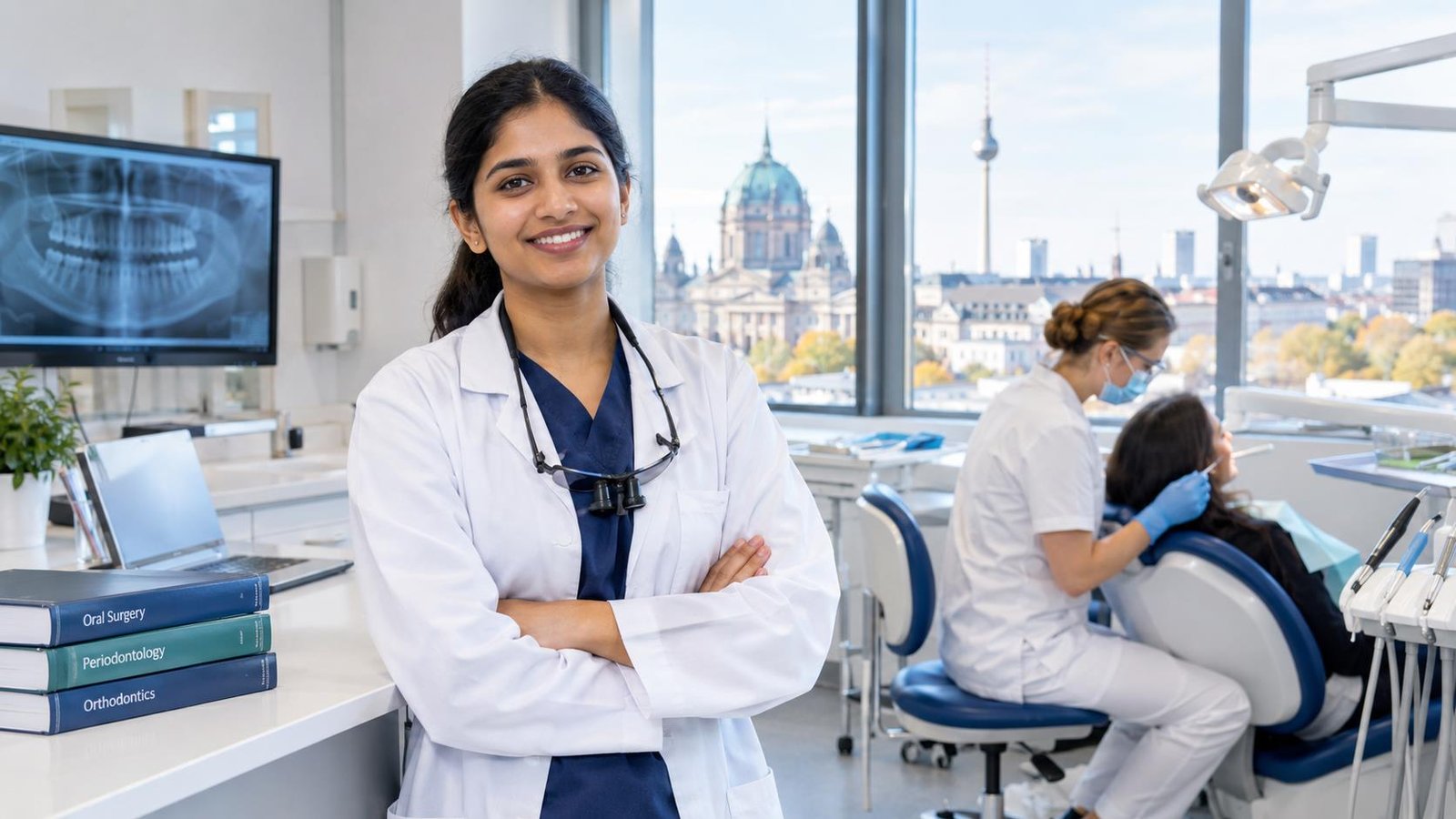
For Indian BDS graduates, Germany has become an option to explore for those looking to build a dental career abroad. However, the pathway is different from the familiar BDS-to-MDS route in India. Before you can work as a dentist, you generally need to go through qualification recognition and the German dental licensing process, along with meeting language requirements.
This makes it important to understand the process before making decisions about language courses, document preparation, exams, employment, or relocation.
What Is Dental PG in Germany?
The term Dental PG in Germany is commonly used by Indian students and graduates to describe postgraduate dental education, specialist training, and career progression in Germany after completing BDS.
However, Germany does not simply follow the same BDS → MDS structure used in India. Depending on your career goal, you may need to follow a pathway involving recognition of your foreign dental qualification, German language proficiency, professional licensing, and clinical employment or further specialist training.
For an Indian BDS graduate, the process can therefore involve several stages:
BDS in India → German language preparation → Recognition of dental qualification → FSP and other required examinations → Approbation or applicable professional permission → Dental employment → Further specialist training
The exact route can depend on your individual qualification, the competent authority handling your application, and the outcome of the recognition process.
Can Indian BDS Graduates Pursue Dental PG in Germany?
Yes, Indian BDS graduates can explore postgraduate dental education and professional opportunities in Germany. However, having a BDS degree alone does not automatically give a foreign graduate the right to practice dentistry independently in Germany.
The first major step is understanding how your dental qualification will be assessed for professional recognition.
For many foreign-trained dentists, this means preparing academic and professional documents and submitting an application to the relevant German authority. The authority evaluates the foreign qualification and determines whether it is equivalent to the German qualification or whether additional requirements have to be completed.
Depending on the assessment, an applicant may need to complete further measures before obtaining full professional recognition.
This is why the journey should be viewed as more than simply applying to a German university for a postgraduate dental course.
Why Do Indian BDS Graduates Consider Germany?
Germany can be relevant to Indian dental graduates for several reasons, particularly for those interested in developing a long-term professional career in the country.
Some of the main areas students and graduates consider include:
- Professional opportunities: Germany has an established healthcare and dental-care system with dental practices and clinics across the country.
- Postgraduate development: Dentists can explore further training and specialist career pathways after meeting the applicable professional requirements.
- International career exposure: Working in Germany can provide experience within a European healthcare environment.
- Structured professional pathway: The recognition and licensing system provides a defined framework for foreign-trained healthcare professionals.
- Long-term career planning: Some graduates may consider Germany not only for education but also for employment and long-term professional development.
At the same time, moving to Germany as a foreign-trained dentist requires serious preparation. German language proficiency, qualification recognition, licensing requirements, examination preparation, documentation, finances, and finding suitable employment all need to be considered.
The right approach is therefore to understand the complete pathway before starting the process.
Eligibility for Dental PG in Germany
Eligibility depends on the specific postgraduate or specialist pathway you want to pursue. For an Indian BDS graduate, the first question is usually whether the existing dental qualification can be recognized for professional practice in Germany. Our detailed guide to Dental PG in Germany eligibility covers the key academic, language, recognition and professional requirements you should review before starting the process.
In general, you should be prepared to provide documents relating to your dental education and professional background. These may include your degree certificate, academic records, internship details, professional registration and other supporting documents requested by the competent authority.
Language proficiency is another important part of the process. Dentists need sufficient German-language skills to communicate with patients, colleagues and authorities and to meet the requirements associated with professional licensing.
The requirements can differ depending on the individual case and the German state responsible for processing the application. Therefore, Indian BDS graduates should check the requirements of the relevant authority rather than relying only on general information found online.
Key areas to check before starting
| Requirement area | What you should understand |
|---|---|
| BDS qualification | Whether your dental qualification is eligible for recognition |
| Academic documents | Degree, transcripts and other education records |
| Internship | Details of compulsory dental training or internship |
| Professional registration | Relevant registration and professional documents |
| German language | General and professional language requirements |
| FSP | Whether a dental/medical language examination is required |
| Recognition assessment | Whether your qualification is considered equivalent |
| Additional examination | Whether further assessment or an examination is required |
| Professional license | Requirements for Approbation or another applicable permission |
| Employment | Requirements for working in a dental practice or clinic |
Because these requirements can change and may depend on the competent authority, applicants should verify the current rules before submitting an application.
Is an Indian BDS Degree Recognized in Germany?
An Indian BDS degree can be submitted for professional recognition in Germany, but recognition is not automatic simply because you hold a BDS qualification from India.
Germany assesses foreign professional qualifications through a formal recognition process. For dentists, the relevant German profession is Zahnarzt/Zahnärztin, and the competent authority evaluates whether the foreign dental qualification is equivalent to the German qualification.
The assessment is based on your education and professional training and may involve reviewing your academic records, clinical training, internship, professional experience and other documents.
If the authority determines that your qualification is equivalent to the German qualification and you meet the other requirements, you can proceed toward professional licensing.
If substantial differences are identified, you may receive a decision that outlines the additional requirements you need to fulfil. This is where terms such as Defizitbescheid and Kenntnisprüfung become important for foreign-trained dentists.
Therefore, Indian BDS graduates should think of degree recognition as a process rather than a simple acceptance of their university degree.
How Does Dental Degree Recognition Work in Germany?
The recognition process starts with identifying the competent authority for the German state where you intend to work or where your application is being processed.
You generally need to collect and submit documents proving your education, professional qualifications and personal identity. Depending on the authority and your circumstances, documents may need to be translated into German and submitted in the required format.
A typical process can involve the following stages:
1. Identify the Competent Authority
Germany has different authorities responsible for professional recognition and licensing. The authority responsible depends on the profession and the federal state.
Before preparing your application, determine which authority is responsible for your case.
2. Prepare Your Documents
Foreign-trained dentists should expect to provide documentation related to their BDS education and professional background.
Common documents may include:
- BDS degree certificate
- Academic transcripts or mark sheets
- Details of subjects and clinical training
- Internship certificate
- Professional registration documents
- Certificate of current professional status, where applicable
- Passport or identity documents
- Curriculum vitae
- German-language certificates
- Evidence of professional experience, where applicable
The exact list can vary, so applicants should follow the requirements provided by the competent authority handling their application.
3. Submit the Recognition Application
Once the documents are prepared, the application is submitted to the responsible authority.
The authority reviews the foreign qualification against the relevant German professional requirements.
4. Receive the Assessment
There are different possible outcomes.
Your qualification may be considered equivalent, or the authority may identify substantial differences that need to be addressed before full professional recognition can be granted.
For foreign dentists, the assessment outcome is therefore an important milestone because it determines what needs to happen next.
5. Complete Additional Requirements If Necessary
If the authority identifies differences between your training and the German reference qualification, you may need to complete additional requirements.
For some applicants, this can involve a Kenntnisprüfung, or knowledge examination, depending on the recognition decision and applicable rules.
The exact requirements should always be confirmed with the authority responsible for your application.
What Is a Defizitbescheid for Foreign Dentists?
A Defizitbescheid is a decision issued during the recognition process when the competent authority identifies substantial differences between a foreign professional qualification and the corresponding German qualification.
For an Indian BDS graduate, receiving a Defizitbescheid does not necessarily mean that the entire process has ended. Instead, it tells you what qualification differences or additional requirements have been identified and what you may need to do to continue toward recognition.
The contents of the decision are important because your next steps depend on what the authority has determined in your individual case.
This is why applicants should read the decision carefully and understand which requirements apply to them rather than assuming that every foreign-trained dentist will follow exactly the same route.
Related guide: What Is a Defizitbescheid for Foreign Dentists in Germany?
What Is Approbation for Dentists in Germany?
Approbation is the German professional license that allows a person to practice a regulated healthcare profession on a permanent basis, subject to the applicable professional rules.
For dentists, obtaining Approbation is a major milestone because dentistry is a regulated profession in Germany.
For an Indian BDS graduate, the pathway toward Approbation generally involves more than presenting the BDS certificate. The applicant must meet the applicable requirements for recognition and professional licensing, including language and other requirements determined by the responsible authority.
The recognition assessment is therefore an important part of the overall Approbation journey.
Why Is Approbation Important?
Without the appropriate professional authorization, a foreign-trained dentist cannot simply begin practicing independently as a dentist in Germany.
Approbation provides the professional authorization required for unrestricted professional practice within the scope of the German dental profession.
However, the exact process and requirements should be checked with the competent authority because foreign qualification recognition cases can differ.
Approbation vs Berufserlaubnis for Dentists
Indian BDS graduates often come across two terms during their research: Approbation and Berufserlaubnis.
They are not the same.
| Approbation | Berufserlaubnis |
|---|---|
| Full professional license | Professional permission that can be limited |
| Generally, not limited to a specific employer or location in the same way as a temporary permission | May have restrictions |
| Provides the basis for permanent professional practice | Usually issued for a limited period and subject to applicable conditions |
| Requires fulfilment of the applicable recognition and licensing requirements | Requirements and scope depend on the individual case and state authority |
A Berufserlaubnis can therefore be relevant to some foreign-trained dentists during their pathway, but applicants should not assume that it is automatically available or that it provides the same rights as Approbation.
What Is the Fachsprachprüfung for Dentists?
German language ability is particularly important for dentists because dental practice involves direct communication with patients and healthcare professionals.
The Fachsprachprüfung (FSP) is a professional-language examination used in the recognition and licensing process for foreign-trained healthcare professionals. The exact requirements and examination arrangements depend on the responsible authority and profession.
For dentists, professional German involves much more than everyday conversation.
You may need to communicate about:
- Patient history
- Dental symptoms
- Diagnosis
- Treatment options
- Risks and complications
- Medical and dental terminology
- Treatment instructions
- Professional communication with colleagues
This is why reaching a general German level and being prepared for professional communication are two different things.
Related guide: Fachsprachprüfung for Dentists in Germany: Complete Guide
Do Indian BDS Graduates Need B2 or C1 German?
Language requirements should be checked against the current requirements of the authority responsible for your application.
In general, foreign-trained healthcare professionals need German-language proficiency for professional recognition and practice, and professional-language competence is an important part of the licensing pathway.
Many applicants encounter B2 and C1 requirements during their research. However, applicants should distinguish between:
- General German-language proficiency
- Professional-language proficiency
- The specific language certificate accepted by the authority
- The requirement to pass a professional-language examination such as the FSP
Simply holding a B2 or C1 certificate does not automatically mean that all licensing requirements have been fulfilled.
What Is the Kenntnisprüfung for Dentists?
The Kenntnisprüfung is a knowledge examination that can become relevant when the competent authority determines that substantial differences exist between the foreign qualification and the German qualification and those differences cannot otherwise be compensated for through the applicable recognition route.
For dentists, the examination is intended to assess relevant professional knowledge required for practicing the profession in Germany.
Whether you need to take the examination depends on the assessment of your individual qualification and the decision issued by the responsible authority.
This is why Defizitbescheid is so important for applicants whose qualifications are not considered fully equivalent.
FSP vs Kenntnisprüfung: What Is the Difference?
These two examinations address different areas.
| FSP | Kenntnisprüfung |
|---|---|
| Focuses on professional German communication | Focuses on professional knowledge |
| Tests communication relevant to healthcare practice | Assesses relevant professional knowledge |
| Connected to language/professional communication requirements | Can be part of the recognition process where substantial differences are identified |
| Preparation focuses heavily on terminology and professional communication | Preparation focuses on dental knowledge and professional practice |
An applicant may encounter both during the overall recognition and licensing journey, but the exact requirements depend on the individual case.
What Happens After Recognition and Licensing?
Once you have completed the requirements applicable to your case and obtained the necessary professional authorization, you can move forward with your dental career in Germany.
Your next step may involve:
- Looking for a suitable dental position
- Joining a dental practice or clinic
- Building professional experience in Germany
- Exploring further dental training
- Considering specialist career pathways
- Planning your longer-term professional development
For Indian BDS graduates, it is useful to think of recognition and licensing as the foundation of the German dental career pathway rather than the final destination.
The long-term goal may be employment, specialist training, or another professional route depending on your qualifications and career plans.
Dental Specialization in Germany After BDS in India
For Indian BDS graduates, one of the biggest questions is what postgraduate or specialist options are available after completing the German recognition and licensing pathway.
Germany’s dental education and specialist training structure is different from India’s BDS-MDS system. Therefore, it is important not to assume that every German postgraduate qualification is directly equivalent to an Indian MDS.
Depending on your professional goals, you may explore further dental training or specialist development after meeting the requirements for practicing dentistry in Germany.
The exact pathway, duration and eligibility can vary depending on the specialty, training institution, state and professional regulations.
Can Indian BDS Graduates Do Dental Specialization in Germany?
Indian BDS graduates can explore specialist dental training in Germany, but the first priority is generally to establish the professional foundation needed to practice dentistry.
This means understanding:
BDS → Qualification recognition → German language → Required examinations → Professional authorization → Dental employment/training → Further specialization
The specific requirements should be confirmed for the specialty and region you are considering.
MDS in India vs Dental Specialization in Germany
The two pathways should not be treated as identical.
An Indian MDS is a postgraduate dental degree awarded through India’s higher-education system. Germany has its own professional and postgraduate training structures, and specialist qualifications may be governed by professional bodies and regional regulations.
| MDS in India | Dental specialization in Germany |
|---|---|
| Formal postgraduate dental degree | May involve structured specialist/professional training |
| Usually follows BDS admission requirements | Entry requirements depend on the specific German pathway |
| Commonly completed within a university-based postgraduate structure | Training structure can involve dental practices, clinics and recognized training institutions |
| Specialization follows the Indian dental education framework | Specialization follows German professional and regional regulations |
If your goal is a specialist career in Germany, research the specific specialty and its current training regulations instead of assuming that the German pathway is simply an equivalent MDS programme.
Dental Specialization Options to Explore in Germany
The opportunities available to a dentist depend on the applicable professional framework and training positions.
Areas that Indian BDS graduates may research include:
- Orthodontics
- Oral surgery
- Periodontology
- Prosthodontics
- Endodontics
- Pediatric dentistry
- Restorative dentistry
- Oral and maxillofacial surgery, where the applicable professional and medical qualifications are met
Not every area follows the same training pathway. Some fields have specific requirements that need to be understood before planning your career.
Related guide: Dental Specialization in Germany After BDS.
Dentist Jobs in Germany for Indian BDS Graduates
After completing the applicable recognition and professional licensing requirements, finding employment becomes an important part of the journey.
Indian BDS graduates should understand that the German job market is different from the Indian dental market. Employers may expect strong German communication skills, professional documentation and an understanding of how dental practices operate in Germany.
Depending on your qualifications and professional authorization, you may explore positions in:
- Dental practices
- Dental clinics
- Healthcare organizations
- Training positions
- Specialist dental settings
The type of position available to you depends on your professional status and the requirements attached to your recognition or license.
How Can You Find Dental Jobs in Germany?
A practical job-search process can include:
- Preparing a German-style CV.
- Collecting your professional and academic documents.
- Understanding your licensing status.
- Searching German dental job portals and practice websites.
- Applying directly to suitable employers.
- Preparing for interviews in German.
- Understanding the employment contract before accepting a position.
Professional German is particularly important during interviews and patient-facing work.
Dentist Salary in Germany
Salary is another common search topic among Indian BDS graduates considering Germany.
However, there is no single salary figure that applies to every dentist.
Income can vary based on factors such as:
- Professional experience
- Qualification and licensing status
- Type of employer
- Region
- Working hours
- Employment contract
- Professional role
- Further specialization
When researching salary figures, it is also important to distinguish between gross salary and net salary.
Gross salary is the amount before deductions, while net salary is what remains after applicable taxes and social-security contributions.
Cost of Dental PG in Germany
The overall cost of pursuing a dental career in Germany depends heavily on the pathway you follow.
Indian BDS graduates should budget for several categories rather than thinking only about university tuition.
Potential expenses can include:
- German language courses
- Language examination fees
- Document translation
- Document certification
- Recognition application fees
- Professional examination fees
- Visa-related expenses
- Travel
- Accommodation
- Food
- Health insurance
- Local transportation
- Other settlement expenses
Whether you pay tuition also depends on the type of programme and institution. Professional recognition and employment pathways are not the same as enrolling in a conventional university degree.
This distinction is important when someone searches for “free Dental PG in Germany.”
A programme or professional pathway may have low or no tuition in a particular setting, but that does not mean the entire process is free.
Is Dental PG in Germany Free?
The answer depends on what you mean by “Dental PG.”
If you are referring to a university-based postgraduate programme, tuition and semester-related charges depend on the institution, programme and state.
If you are referring to the professional route taken by a foreign-trained dentist, the major expenses can instead come from recognition, language preparation, examinations, relocation and living costs.
Therefore, Indian BDS graduates should calculate the total cost of the pathway, rather than focusing only on tuition fees.
Germany Visa for Indian Dentists
Visa planning is another important stage for Indian BDS graduates who want to move to Germany.
The appropriate visa route depends on the purpose of your stay and your circumstances. A person coming to Germany for recognition-related purposes may have different requirements from someone who already has a qualifying employment offer.
Before applying, applicants should check the current requirements of the German authorities and the German mission responsible for their application in India.
Documents may include, depending on the visa category:
- Valid passport
- Visa application forms
- Proof of purpose of stay
- Educational and professional documents
- Recognition-related documents
- Proof of financial resources
- Health insurance
- Accommodation details where required
- Other documents specified for the particular visa category
Visa requirements can change, so applicants should always use current official information when preparing their application.
BDS to Germany: Step-by-Step Process
For an Indian BDS graduate, the overall journey can be easier to understand when divided into stages.
Step 1: Complete BDS
Start with your recognized BDS qualification and collect all relevant academic and professional documents.
Step 2: Learn German
Build your German language skills early. Professional dental communication requires more than basic conversational German.
Step 3: Research the Recognition Authority
Identify the competent authority responsible for your professional recognition and licensing application.
Step 4: Prepare Your Documents
Organise your degree, transcripts, internship records, professional registration and other documents according to the authority’s requirements.
Step 5: Apply for Recognition
Submit the recognition application and wait for the authority’s assessment.
Step 6: Understand the Assessment
The authority may recognize the qualification as equivalent or identify differences requiring additional measures.
Step 7: Complete Language and Examination Requirements
Depending on your case, you may need to complete professional-language requirements and potentially additional professional examinations.
Step 8: Obtain the Required Professional Authorization
Once all applicable requirements have been fulfilled, proceed with the relevant professional license or permission.
Step 9: Find Dental Employment or Training
With the appropriate professional status, you can explore suitable employment and further professional training.
Step 10: Plan Your Specialization
After establishing your professional pathway, you can investigate specialist training and longer-term career opportunities.
How Long Does It Take to Become a Dentist in Germany After BDS in India?
There is no universal timeline for every Indian BDS graduate.
The duration can depend on:
- Your German language level
- Document preparation
- Recognition processing time
- The Competent authority
- Whether additional training is required
- FSP requirements
- Whether a knowledge examination is required
- Examination preparation and availability
- Job-search time
- Visa and relocation arrangements
Someone who already has strong German language skills and complete documentation may have a different timeline from someone starting German from the beginning.
For this reason, it is better to plan the process as a series of stages rather than relying on a fixed number of months.
Common Mistakes Indian BDS Graduates Should Avoid
Starting Without Understanding the Licensing Process
Germany’s dental profession is regulated. Understanding recognition and professional licensing should come before making major relocation decisions.
Treating B2 or C1 as the Entire Language Requirement
A general German certificate is not necessarily the same thing as being prepared for professional dental communication or fulfilling every language-related requirement.
Assuming BDS Is Automatically Equivalent
A foreign BDS qualification must go through the applicable recognition process. Do not assume that holding the degree automatically gives you the same professional rights as a German dental qualification.
Confusing Berufserlaubnis with Approbation
These are different forms of professional authorization and can have different conditions and limitations.
Ignoring the Defizitbescheid
If your recognition decision identifies substantial differences, the decision should be understood carefully because it determines the next steps applicable to your case.
Focusing Only on Tuition Fees
Moving to Germany involves language, recognition, examination, visa and living expenses. A realistic financial plan should account for the complete journey.
Choosing a State Without Research
Recognition and licensing are handled by competent authorities, and requirements or procedures can vary. Applicants should research the authority responsible for their individual case.
Relying on Outdated Information
German professional regulations, authority procedures, fees and visa requirements can change. Always verify important details using current official sources before acting.
Growth of Dentists and Healthcare Personnel in Germany (2018–2023)
Germany has seen a gradual increase in both the number of dentists and the wider healthcare workforce over the past several years. The figures below provide historical context on the size of Germany’s dental profession and healthcare sector.
|
Year |
Dentists in Germany | Healthcare Personnel in Germany |
|---|---|---|
| 2018 | 97,262 | 5.65 million |
| 2019 | 98,310 | ~5.7 million |
| 2020 | 99,592 | ~5.8 million |
| 2021 | 100,504 | ~6.0 million |
| 2022 | 101,344 | ~6.0 million |
| 2023 | 102,584 | ~6.1 million |
| 2024 | 103,102 | ~6.2 million |
| 2025 | 104,632 | ~6.2 million |
Source: Dentist figures: Kassenzahnärztliche Bundesvereinigung (KZBV), Jahrbuch 2025, Table 6.1, based on data from the Bundeszahnärztekammer (BZÄK) and Statistisches Bundesamt (Destatis). Healthcare personnel figures: Statistisches Bundesamt (Destatis), Gesundheitspersonalrechnung (Health Personnel Accounts), annual data for 2018–2025.
Why Choose MissionGermany?
Planning a dental career in Germany involves more than selecting a course. Indian BDS graduates need to understand recognition, German language requirements, professional licensing, examinations, employment and the wider relocation process.
MissionGermany provides guidance for students and medical professionals exploring Medical PG in Germany and Dental PG in Germany.
For dental graduates, the focus should be on understanding your individual qualification, identifying the applicable pathway and preparing each stage carefully.
The right information at the beginning can help you avoid unnecessary delays and make better-informed decisions about your Germany career plan.
Final Thoughts
For Indian BDS graduates, Germany can provide a pathway to professional development, employment and further dental specialization. But the journey is not simply a matter of applying for a postgraduate course.
Recognition of your dental qualification, German language proficiency, professional examinations, Approbation or applicable professional permission, employment and financial planning can all play important roles.
The best place to begin is by understanding your individual situation and the requirements that apply to your intended pathway. Once you know what lies ahead, you can plan your language preparation, documentation, recognition application and career steps more systematically.
Frequently Asked Questions
Can an Indian BDS graduate work as a dentist in Germany?
Indian BDS graduates can pursue professional recognition in Germany, but a foreign dental degree does not automatically grant the right to practice. You need to meet the applicable recognition, language and professional licensing requirements.
Is Dental PG in Germany the same as MDS in India?
No. Germany and India have different postgraduate dental education and professional training structures. Indian BDS graduates should research the specific German specialization or training pathway rather than treating it as an automatic equivalent of MDS.
Do Indian dentists need German language skills?
Yes, German language proficiency is an important part of the pathway for foreign-trained dentists because professional practice involves communication with patients, colleagues and authorities. The exact requirements should be confirmed with the relevant authority.
What is Defizitbescheid?
A Defizitbescheid is a recognition decision that identifies substantial differences between a foreign professional qualification and the corresponding German qualification. It can explain which additional requirements need to be completed.
What is Approbation for dentists?
Approbation is the German professional license for practicing a regulated healthcare profession on a permanent basis, subject to the applicable rules. For dentists, obtaining appropriate professional authorization is a key part of the pathway to practicing independently.
Ready to Explore Dental PG in Germany?
If you are an Indian BDS graduate planning to build your dental career in Germany, understanding the pathway before you begin can make the process much easier to plan.
From qualification recognition and German language preparation to professional licensing, examinations, employment and further specialization, each stage needs careful attention.
MissionGermany can help you understand the available pathway and plan your next steps toward a dental career in Germany.
Have questions about your pathway? Contact MissionGermany to discuss your next steps.