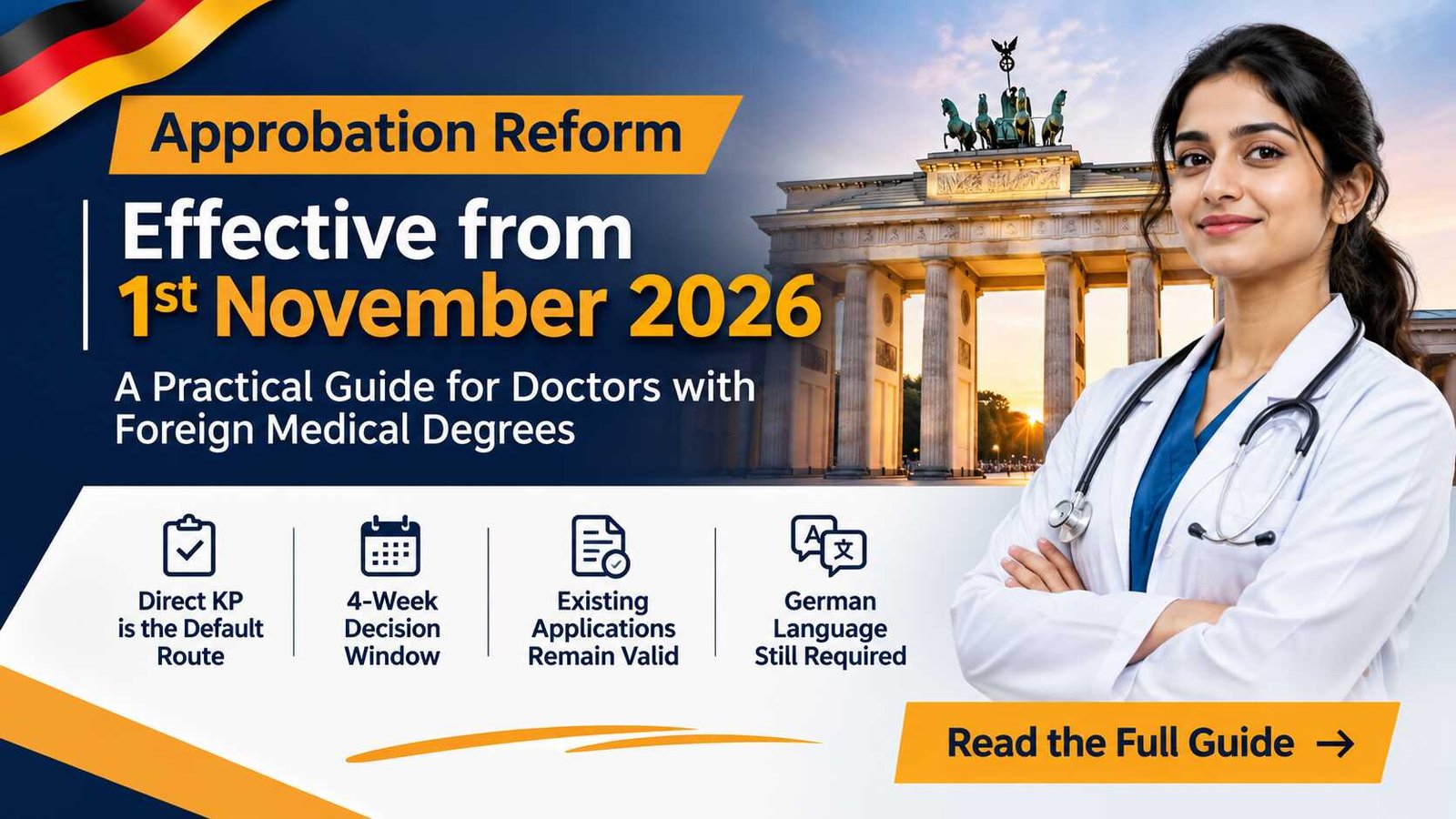
Approbation reform effective 1stNovember 2026
Practical guide for doctors with foreign medical degrees
Nationwide guide for all German federal states
Bottom line. A federal law has been enacted, and its main Approbation changes take effect on 1st November 2026. For doctors trained in third countries, the Kenntnisprüfung becomes the standard route, while a document-based equivalence review remains optional. Critically, applications already filed by 31st October retain the previous recognition rules.
The changes briefly
| Topic | Before 1st November 2026 | For new applications from 1st November |
| Recognition route | Document-based equivalence review was ordinarily the starting point. | Direct Kenntnisprüfung (KP) is the default route for third-country medical qualifications. |
| Choosing document review | Equivalence review could lead to recognition or a KP if important differences remained. | Applicants can elect equivalence review only within four weeks after filing; the choice binds the Approbation procedure. |
| Existing applications | Applications filed through 31st October use the earlier BÄO recognition provisions. | Old applications do not automatically switch to the new KP-default procedure. |
| Qualification papers | Detailed study plans and curricula were commonly required for equivalence comparison. | On the direct-KP route, documents used solely for that comparison generally cease to be necessary; core credentials remain required. |
| Language assessment | Professional German remained a licensing requirement. | Still required; states may examine language skills before deciding professional qualification. |
1. Who the reform concerns
The central rule is § 9d of the amended Bundesärzteordnung (BÄO). It concerns completed medical qualifications obtained in a “Drittstaat” (a country outside the EU and EEA, subject to specific equal-status rules). The country where the medical qualification was obtained matters; citizenship alone does not decide the recognition route.
EU, EEA and corresponding Swiss qualifications continue under their separate recognition framework, principally § 9c BÄO. They should not be described as newly subject to the same default Kenntnisprüfung.
2. Two pathways for new third-country applications
Path A Direct Kenntnisprüfung — the default. After the qualification and other necessary documents are checked, the applicant proves the required medical knowledge and abilities through the KP. A prior curriculum-by-curriculum deficit assessment is not a prerequisite under this route. Passing the KP does not remove the separate language, personal suitability, health and documentation requirements.
Path B Document-based equivalence review — by timely choice. A candidate may instead request an individual Gleichwertigkeitsprüfung of the foreign medical qualification. That decision must be made within four weeks of filing the application and remains binding for the entire Approbation procedure. If essential differences are found, or review cannot reasonably be completed for specified reasons, a KP can still be required.
Practical consequence: a doctor whose education is well documented and plausibly equivalent may prefer a formal review; someone facing a long, expensive curricular assessment may prefer direct KP. Neither route guarantees a quicker appointment or a positive decision. Ask the authority to explain both options before the four-week window ends.
3. The transition date is especially important
Applications filed on or before 31st October 2026. Under the new § 15 BÄO, the old § 3(2)– (3) recognition rules continue to apply to the examination of qualifications from third countries. A pending file, an existing assessment or a Defizitbescheid is not automatically invalidated merely because the calendar reaches November.
Applications filed on or after 1st November 2026. The new § 9d pathway applies, including the four-week election deadline for documentary equivalence assessment.
Keep proof of the date the competent authority received your application. If a file was sent before the deadline but receipt, completeness or legal classification is disputed, obtain written confirmation from the authority rather than assuming which regime applies.
4. What does not disappear
- Approbation is still required for unrestricted medical practice. A successful KP is only one element of the licensing process; medical-degree authenticity, health, reliability and German-language requirements remain relevant.
- Berufserlaubnis under § 10 BÄO continues as a separate form of permission. The reform does not grant it automatically, nor does a job offer itself permit clinical work.
- Approbation is valid throughout Germany and does not expire. Berufserlaubnis is ordinarily time-limited and may be restricted to a state or even an individual workplace.
- Medical specialty training (Facharztweiterbildung) is regulated by each Landesärztekammer. According to the Bundesärztekammer, training can start after Approbation or Berufserlaubnis; the recognition of particular training periods and posts must be clarified with the relevant chamber.
- The new law allows an unlimited-duration Berufserlaubnis only in narrowly defined exceptional cases. This is not a general removal of the usual time limit for international doctors.
- The option for partial practice under § 10b BÄO concerns qualifying EU/EEA/equal-status situations; it is not a general shortcut for degrees from third countries.
- Which federal state authority is responsible
A notable change is the new § 12(2a) BÄO: for decisions on recognition of qualifications under §§ 9b–9d, a person ordinarily resident in Germany is generally assigned to the authority of the state of that ordinary residence. If the person is not resident in Germany, the intended state of medical practice governs. By contrast, a Berufserlaubnis under § 10 is handled in the state where the physician plans to practice (§ 12(3)).
Example. A physician who ordinarily lives in one federal state but has a hospital offer in another should clarify Approbation recognition with the residence-state authority under the new rule. A temporary Berufserlaubnis for work in the second state is a separate application handled where the work is planned. Existing proceedings filed before November need individual confirmation; do not withdraw or re-file without advice.
The Approbationsbehörden of the Länder administer licensing applications. Their local forms, implementation instructions, language-exam processes and processing times may differ. Use the official recognition finder to identify the competent authority rather than assuming one nationwide office handles all applicants.
6. Language, exams and implementing regulations
The reform does not waive the required professional German assessment or make a B2 certificate alone sufficient for unrestricted medical practice. In general, authorities require B2 general German and a medical-language test aligned with C1, although exemptions or details vary by state. States can now assess language competence earlier; applicants should follow the competent authority’s written instructions.
A related regulation amending the Approbationsordnung für Ärzte was approved by the Bundesrat on 16th October 2026 with amendments. It includes new rules for examination procedures and application documents. As of 28th October, the official implementing text should be checked for final promulgation before relying on its detailed KP timetable or format; a Bundesrat-approved draft is not itself the final promulgated rule.
7. Questions worth asking the authority
For an existing application: “Mein Antrag auf Approbation ist am [Datum] eingegangen. Können Sie bitte bestätigen, dass auf mein Anerkennungsverfahren gemäß § 15 BÄO weiterhin die bisherige Rechtslage Anwendung findet?”
For a new application: “Bitte erläutern Sie mir die Wahlmöglichkeiten nach § 9d Abs. 2 und 3 BÄO, die verbindliche Frist sowie die zuständige Behörde nach § 12 Abs. 2a BÄO.”
Illustrative application scenarios
| Situation | What it means in practice |
| Third-country application received in September 2026 | The former substantive recognition rules remain relevant under § 15 BÄO, even if the case remains open in November. |
| Third-country application received on 3rd November 2026 | Direct KP is the default; elect the document-based review within four weeks if that is the preferred route. |
| Medical curriculum is incomplete or difficult to authenticate | The direct route may reduce the need for a detailed equivalence dossier, but identity, degree validity and other core checks still apply. |
| Doctor lives in one federal state but has a job offer in another | For a new case, confirm Approbation recognition jurisdiction based on ordinary residence; seek the Berufserlaubnis from the authority responsible for the intended work location. |